-
Things are Getting Weird…
Okay.
Hmm.
I wasn’t sure if I was going to write about this, but…things are getting weird, and a little writing therapy sounds comforting right now.
In April 2023, I spent $47 to fly from Tokyo to the US, and it was just so incredible. Can you imagine the high of getting to fly internationally for that cheap? I was able to do that because I’m a flight attendant. My family flew separately from me because they do have the same flight benefits on other carriers as I do as a flight attendant.
I returned home from that trip and told Saign that I kind of wanted to try again for another airline…one in which my family would also get to fly from Tokyo to the US for just the $47 taxes.
I thought Saign would say “absolutely not,” because training takes me away from the family, and because I wouldn’t be guaranteed a base in SEA, and because losing seniority will hurt, etc, etc, etc.
To my surprise, Saign didn’t tell me I was crazy! He said, “Do it!” He pointed out that the whole point of this job are the flight benefits, so I might as well get the best flight benefits that I can.
In October, I got a conditional job offer with a big airline.
There are many reasons I think this is the right choice. Here are a few: 1) International flight benefits for my family (as discussed above). 2) I truly believe that I will be working for the best carrier in the US; the airline that I am switching to offers a great product, and since I like to do things well, it will feel really really good to me to be able to feel that I’m offering the very best to my passengers. 3) Variety. One of my favorite parts of this job is that it changes every day. New passengers. New destinations. New crews. New experiences. With a bigger airline, I’ll get more variety, and that is very appealing to me. 4) I don’t have much faith that my current airline will be growing and thriving they way that I think it needs to to stay alive and relevant in the years to come.
Oh wait. Yesterday many of these factors got ROCKED. Yesterday, my airline announced that they are acquiring another airline. An airline that flies to Asia. An airline that flies widebodies.
OH.
Maybe my airline is going in a direction I like????
I’m a little…rocked…at this point. I still think my new airline is the right choice.
But I’m heartbroken about leaving my family for 7 weeks to go to traning.
I’m very legitimately worried that I won’t be based in SEA at first, which means more time away from my family as I would commute by airplane to work.
And now I’m wondering if my airline might be changing and growing in such a way that it might become the airline that I’d prefer to be with in 10 years.
Maybe?
Maybe not.
At this point, I’m fairly certain I am switching airlines, but…things are weird right now.
NOTE: Airlines have very strict social media policies, which is why I have never mentioned the name of my current nor future airline online, and I never will!
-
Disney on a Budget…Tokyo Disney

Fact: I love Disneyland! When I lived in Southern California, I had an annual pass to Disney, because I love it that much (it’s the most magical place on earth!)
Fact: The prices at Disney are really ridiculously high these days! I used to hold an annual pass that allowed me to go every day except spring break and on Saturdays during the school year…and it was around $130. Now, tickets for just one day in the park are often $120. We are a family of three…Disney could get expensive really really quickly!
Want to know how to save on Disney tickets? GO TO TOKYO! Seriously. Beautiful, clean, fun parks, and they’re around $60 a day! That’s half off the price of the US parks. (The park prices do vary, so it’s tough to be too specific about prices!) Tokyo has two Disney parks: Tokyo Disney, and Tokyo Disney Sea. Since the tickets are half the price of the US parks, I thought it made sense to spend a day in each!
We brought L to Tokyo Disney and Tokyo Disney Sea in April 2023. It was magical! Afterwards I asked her, “Was it everything you hoped and dreamed?” She replied, “It was better!” This may not seem to be that big of a deal, but L is pretty dang hard to impress. I don’t think she’s ever said that something was better than she imagined before!

I loved Tokyo Disney too! Here are a few tips to help you if you choose to go:
- Buy tickets in advance. At Disney Tokyo they do not sell tickets at the gate. Tickets must be purchased ahead of time. They also cap how many tickets they’ll sell, so buying in advance ensures you’ll get in on the date you want.
- If you’re American, Klook is a reputable ticket dealer. The Tokyo Disney website does not like American credit cards. I tried and couldn’t get it to work. Finally, I followed what Reddit told me to do: I bought through Klook. It worked just fine! If you can’t get your card to work on the Tokyo Disney website, go with Klook.
- Get there before they say they open. We got to the parks about an hour in advance because I read that they typically open 30-45 minutes before their published opening time, and this turned out to be true! We got through the gates well before the published opening time!
- Eat the popcorn. The Tokyo Disney parks are known for having special flavored popcorn. Unique flavors like curry, chocolate, etc. It is fresh, warm, and delicious. Chocolate was my favorite, but chocolate everything is my favorite, so that’s not too surprising!
- To save $$, avoid Disney hotels. We stayed at an AirBnB in Shinjuku Tokyo for $50/night. It was really not that big of a deal to take the train into the Disney parks.
- TRY THE LITTLE GREEN DUMPLINGS. I thought I should try these because they’re adorable, but because they’re called dumplings, I expected them to be savory. To my delight, they’re actually cream-filled mochi! They come in a set of three: vanilla, strawberry, and chocolate.
- Leave walking time for Tokyo Disney Sea if you take the train. We did our first day at Tokyo Disney, and getting there from the train was an easy little walk. I was surprised when we had to walk and walk and walk and walk to get to the Tokyo Disney Sea park. It’s much farther from the train stop!

Here are some unique things about the Tokyo Disney parks:
- Duffy. Yeah. So…he’s a teddy bear that is beloved in Japan??? As far as I know, he’s not featured in any films, but I guess he’s just rumored to be Mickey’s friend, and you’ll see him everywhere in the Tokyo parks. They have lots of Duffy merchandise, have Duffy meet-n-greets, and (most shocking to me) there are a LOT of grown adults walking around cuddling stuffed Duffy bears and taking pictures with their stuffed bears everywhere they go.
- Food! I wrote about my two favorites above, but there are several unique cute food options at the Japanese parks.
- Non-Disney characters. Tokyo Disney and Tokyo Disney Sea are the only Disney parks that are not owned by Disney. Therefore, they have some of their own characters that they use. This was most prominent at Tokyo Disney Sea, where many of the rides were themed around non-Disney characters. L’s favorite was called “Sindbad’s Story Book Voyage.” It featured a boy name Sindbad, and you follow his story on a boat ride through various rooms (It’s a Small World style).
- Unique lands at Tokyo Disney Sea. Tokyo Disney Sea has an incredible huge castle for Ariel called the “Mermaid’s Lagoon.” It’s huge! So huge that several rides fit inside it so that it’s a great place to visit if it rains. There’s also an “Arabian Coast” area, themed after Aladdin. The coolest thing about the Arabian Coast area is that instead of piping a sugary sweet smell into the air, like they do at most Disney parks, at the Arabian Coast, they pipe middle eastern spice smells (kind of curry-esque) into the air. It’s really cool!
- Big poofy headpieces. So you know how we wear mickey ear headbands here in the US? In Japan, huge character stuffy-heads are popular. I’m not explaining this well, but basically it’s a cross between a hat and a legit mascot’s head. They make the wearer look a bit like a bobble head. You’ll think you’re seeing a real character, and then suddenly realize it’s just a regular old park-goer wearing a huge massive character headpiece. It’s pretty unique!
- Lots of characters out and about. Prior to going to the Tokyo parks, I had spent one day at Disney Hong Kong, and many many days at the California Disney Parks. I saw 2x the number of characters up close in the two days I spent at the Tokyo park than I’ve seen in all my other park days combined. Now, I had never been to a Disney park with a kid before, so there is a possibility that I would have seen a lot more characters at the other parks if I had been in the kiddie areas. BUT I actually suspect that character sightings are more thrilling to the Japanese audience than to other audiences, so perhaps they provide more of them! Generally for the drive-by sitings (when the characters are just out and about) in Japan, they will not let adults get very close to them, but most of the time the characters will seek out kids to take pictures with, so L got a lot of pictures with the characters. We did quickly learn that if they characters were just out and about they would NOT sign her autograph book…we had to wait in line to get autographs!

Most importantly: if you’re an adventurous family, going to the Tokyo parks is a great compromise: The kid gets a kid day, and you get to travel and explore another culture for the rest of the week! Everybody wins!
-
How to Travel: A Beginner’s Guide

I’ve had several friends approach me and tell me that they really really want to travel, but they have no clue how. As far as I can understand, they’re simply overwhelmed with choices and unknowns and don’t know where to start. This is for them. Here’s my newbie guide for planning an international trip:
Step One: Pick a Destination. Seriously. Any destination will do. I think some people might get caught up thinking that there’s a way to pick the wrong destination. There’s really not. Every place is cool to visit and every season is interesting to experience. Here are a few things to consider when looking at a destination:
Safety. Some places are safer to visit than others. I’ve visited plenty of places that are considered less-safe, but I’ve never visited a place that I regretted visiting. I do avoid countries that are in the middle of war, but other than that, I do sometimes visit places that it’s not recommended Americans visit. The US State Department puts out travel advisories, so if you’re questioning the safety of a place you’re considering visiting, you can look to see if the US government has any recommendations/warnings related to the destination you’re considering. I’d say if you’re new to travel and are worried about safety, starting out with a country that has no warnings from the State Department is a good way to go.
Price. Some places are more expensive to visit than others, and it is important to factor in what destinations will fit your budget, considering exchange rate, airfare, lodging, food, transportation, safety, and activities. To figure this out, the internet is your friend. You can research hotel prices, or google, “cheap places to travel,” and look up exchange rates online to get a better idea of cost.
Season. For any destination, there are better times to visit weather-wise, but visiting in the off-season can be really cool for it’s own reasons. For example, in 2021, we went to Greece for Christmas. One of the most famous areas in Greece is Oia in Santorini. Oia is the picturesque island town with the blue and white homes on the cliffs; quintessential Greek Island. It’s got adorable cobblestone streets. During the summer, those streets are covered with tourists, and it’s hard to get food at a restaurant without reservations made weeks in advance. In the winter, the streets were quiet. The downside to this was that most restaurants and many shops were closed. We ate at least one meal a day at Vitrin, a crepe and sandwich spot because it was the only restaurant that was reliably open. Oia has a famous bookshop that we didn’t get to see because it was closed the whole time we were there. The upside to being there in the off-season was that we got to experience the town crowd-free. We went to the beach and swam completely by ourselves. We got great sunset views at the castle without needing to get there hours early. I got lots of cool pictures with no tourists in them. All of this is just to say: It’s okay to try a place in the off-season. All places are worth visiting during all seasons. Our family prefers to travel during shoulder seasons because typically the prices for hotels are lower and the crowds are less, but we can still get lots of good weather days.
Conclusion: The main thing I want you to take from this is to consider the factors I mentioned above, and then pick a destination knowing that there is no wrong decision. You can have a fabulous time in any destination, I promise!

Step 2: Research Your Destination The next step is to research your destination to give yourself a good idea of what you might like to see and do while you’re on vacation, and to plan ahead for any entry requirements. This is important to do before you leave so that you are sure you’re allowed to enter the country, know where you may want to stay, know whether or not you need to rent a car, and know which airport(s) you may want to fly in or out of.
Figure out Entry Requirements. You’ll want to know if your destination has any health-related entry requirements, and any visa requirements. How to do this? Google, of course! During COVID, I’d typically just search, “COVID restrictions for US citizens entering __________,” which would give me all the information about tests that we’d need to take or documentation we’d need to complete in order to travel where we wanted. For recommended vaccinations, I typically search “CDC travel ____________” and that brings me to the CDC’s website and tells me what vaccinations/treatments I might need to consider when traveling to the country in question.
Finally, to figure out visas, I search “US citizens visa requirements __________.” From there, I scroll down to the US State Department website to make sure I have the official information about visas for the country I want to visit. I have failed to do this in the past, and then had to frantically complete my visa application online while at the airport, as the airline would not let us board the plan until we had proof of visa. Don’t make that mistake!
Find out What Interests You at Your Destination. How to do this? There are many ways! Some people check out travel books from the library and read them. Some watch YouTube videos. I do a little of both of these, but mostly I use Google. I search “Cool things to see in ______” and “cool things to do in ________.” If I see something interesting in my search, I document it in a Word document. Once my interest list is complete, I get on Google Maps to get an idea of where the things I’m interested in are located. If a lot of the things I want to see are in one area, I’ll put that area on my list of “go-to” spots in the county I’m visiting. I’ll also re-arrange my Word doc according to region so that I’ll have an idea of how many activities I’m interested in in each region.
Step 3: Book Your Flights. If you find a really great deal on a flight, go ahead and book it right away. That gives you 24 hours to complete steps 1 and 2, and you can cancel/modify your flight if you realize that you’d rather fly in/out of different airports, or if you need more time because there are so many interesting things to do at your intended destination. More often though I will complete steps 1 & two and THEN book the flight, because if I complete steps 1 & 2, I’ll have a better idea of where I want to fly in/out of, and how long I’ll want in the country I’m visiting.
Step 4: Pick Your Lodging. Once I have my list of places I want to visit, then I can make decisions about which city/cities/towns I want to stay in during my visit. If I have a lot of things I want to see in one city, I’ll stay there for a longer period of time. If I’m visiting a large city, I’ll often simply Google “best neighborhoods to stay when visiting ________.” Usually from there I’ll come up with 2-3 good options and then I’ll book hotels/AirBnBs in the more affordable of the recommended neighborhoods.
I do tend to take a long time picking lodging. I look at prices. I look at reviews. I search on various booking sites. The result is that we often stay in really cool places for relatively low prices. Buuuut, it does take a long time!
A note here: I have not always booked lodging before leaving the US. Experimenting with doing both (booking ahead vs not) I’ve found that if I don’t book lodging ahead of time, I basically end up with two choices: 1) spending time that I could be spending exploring a cool place searching for a hotel, or 2) paying a LOT of money for hotels. Often, it’s actually a combination of both of these things! Thus, I now land solidly in the book-lodging-ahead-of-time category.
Step 5: Book Things that Must Be Booked Ahead of Time. Remember that interest list that I created in step 2? I’m a pretty big fan of using that list for ideas of what to do while I’m traveling. But sometimes there are things that must be booked weeks/months in advance, (for example: things that might sell out) so for those things I do book them while I’m at home. Examples of things that need to be booked ahead of time? Visiting the crown at the Statue of Liberty (must be booked months in advance), Tokyo Disney (they sometimes sell out), Afternoon Tea (I loooooooove going to afternoon tea, but you usually need to book it 2 days in advance. Therefore, I just book it while I’m at home to make sure it’s all taken care of). There are people who like to plan every second of their vacation. I don’t. I have a list of things that interest me, have lodging in place, and then only book the things that I might miss out on if I don’t book in advance.
It’s also at this time that I would book a rental car if we decide that we need one for our trip, and complete any visa paperwork that is needed.
Step 6: GO! Yep, that’s it. After you’ve done steps 1-5 you’re all ready to go! HAVE FUN!
I hope this is somewhat helpful to my wannabe traveler friends!
-
Let’s Talk about Christmas…and Fair Pay
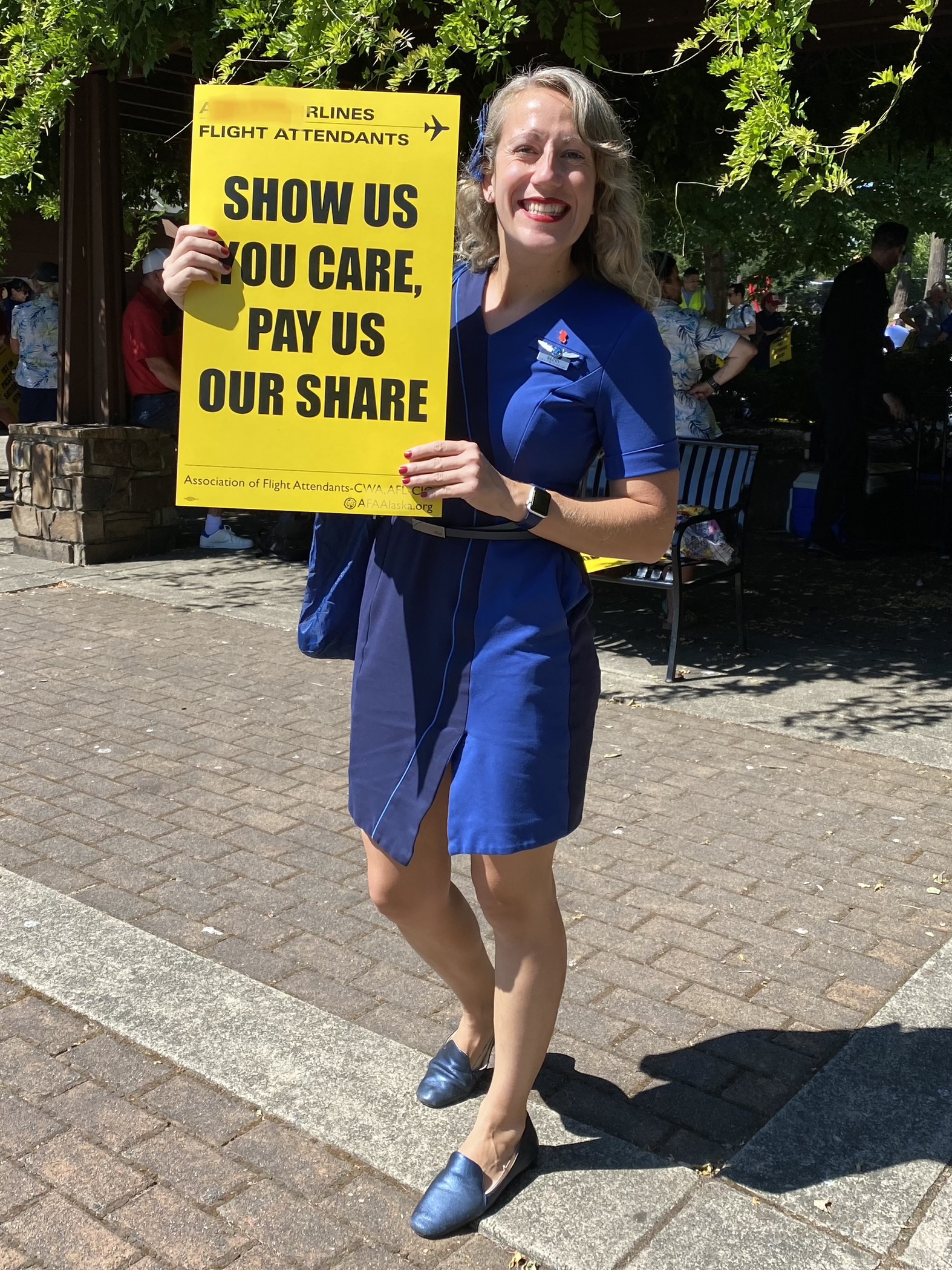
I know it’s August and all, but today is picketing day for my union, so I think it’s a good day to discuss what happened for me on Christmas to demonstrate the unfair labor practices of the airline industry in the US.
I don’t know if you all remember, but basically the Pacific Northwest completely melted down on Christmas Eve 2022. It doesn’t snow or freeze all that often here in the PNW, so as a result we don’t have the plows and other equipment that I’m accustomed to in the midwest. The PNW always falls apart when there’s snow. The airline industry also falls apart. We don’t have enough plows, de-icers, or salt trucks to address snow and ice. Further, even if we did, some winter conditions simply are not safe to fly in.
Here’s what happened to me at Christmas time:
My company pays us 2x our normal pay rate for flying on Christmas Eve and Christmas. I volunteered to work these days because I have so much guilt about the piddly little money I bring into the household now that I’m a flight attendant. About a week before Christmas, Saign told me he thought I was very silly. He pointed out how low my pay is anyway. He said, “So if you get paid double on Christmas, you’ll make, like, $100 extra, right?” I thought about it for a moment, “Yes…” I said. “Is $100 worth missing Christmas?”
OH MY GOODNESS. I realized he was right. I was missing Christmas with my young daughter for $100. That WAS ridiculous. I decided that I had made a terrible mistake. At that point though, there was nothing to be done, I was going to have to work on Christmas, it was already on my schedule.
On December 23rd, I was able to self-assign a trip for Christmas Eve and Christmas. I was going to spend Christmas Eve and Christmas Day in Puerto Vallarta! Suddenly it felt like maybe I hadn’t made a terrible mistake. Maybe it would all be okay…
On Christmas Eve morning, I made my way to the airport. My first leg of the day was a 1 hour flight to Portland. From there I would fly to PVR.
I successfully made it to Portland, where ice was delaying flights, including the flight that I was supposed to work to Mexico. It turned into what is called a “rolling delay,” with the flight being pushed further and further back. Around 1 hour before the newest flight time, I made my way to the gates and met my crew (at that point, I had sat at the Portland airport for over 4 hours as the flight was continually delayed). While we were standing there, I looked at my company phone and saw that the flight to PVR was cancelled. My crew and I walked away and called Crew Scheduling to ask what we should do next. We reached a message stating that we would need to leave our number for a call back.
We then had to wait.
Not being able to contact Crew Scheduling put us into a holding pattern: According to our contract, we must remain at the airport until we are released by Crew Scheduling, but…we couldn’t reach Crew Scheduling to be released.
Many of the crew around me were upset because while they were “pay protected,” meaning they would get paid for the hours of flying they were missing, but holiday pay is NOT pay protected so they would not get the double pay they had been counting on.
Meanwhile, as a reserve flight attendant, I was NOT pay protected. During the hours I spent at the airport, I reviewed our contract and I couldn’t figure out if I would even be paid anything. According to our contract, I am supposed to be given a hotel room if I have more than 4 hours between flights, but since Crew Scheduling was non-contactable, I was not given a hotel room. The automated system assumed I had been given a hotel room, so listed me as being off-duty, despite the fact that I was still on-duty. Because I was essentially abandoned at the airport, I wasn’t sure if I would be paid at all for the time I spent waiting to be released by Crew Scheduling.
About an hour after our flight was cancelled, both my company AND the Portland Airport put out statements on their websites saying that there would be no more flights leaving Portland that day. While I still couldn’t speak to Crew Scheduling, other flight attendants in my company were ahead of me in the phone queue and did speak to Crew Scheduling. They were told they had to remain at the airport, “In case we need to put you on another flight.” When these flight attendants pointed out that no flights would be leaving PDX per both the airport and our company, they were told that this was inaccurate and they would have to remain at the airport.
So there we sat, trapped. If we left, we’d risk getting fired for leaving. I had no place to go anyway, because Crew Scheduling hadn’t given me a hotel.
In total, I sat at the airport for 10 hours. After 10 hours, Crew Scheduling finally called one of my crew members who made sure they arranged a hotel for all of us.
At 11:00pm that night, Crew Scheduling called me and asked me if I needed anything, since I had put my number in for a call back. I explained that I needed to be marked as “on-duty” for the entire time I was stuck at the airport since I wasn’t offered a hotel.
I spent a long time that evening contacting my union reviewing the problem with contacting Crew Scheduling and requesting compensation. In the end? I got paid half-pay for the 10 hours I was trapped at the airport. To clarify, half-pay is below Oregon’s (and Washington’s) minimum wage. I spent Christmas Eve away from my family getting paid below the legal minimum wage.
So…how do airlines get away with paying its employees so poorly? An archaic law called the Railway Act allows airlines and railway companies to mistreat their employees. In this case, I was paid below minimum wage for the time I was trapped. On a normal work day, I spend plenty of time “on duty” while getting paid nothing.
And that, my friends, is why I spent today picketing in the heat with thousands of my colleagues to bring attention to the poor work conditions and pay that we tolerate as our company and shareholders make insane profits. Please support your flight attendants, many of whom are in a stalemate with their companies as we attempt to just get treated like normal American employees.
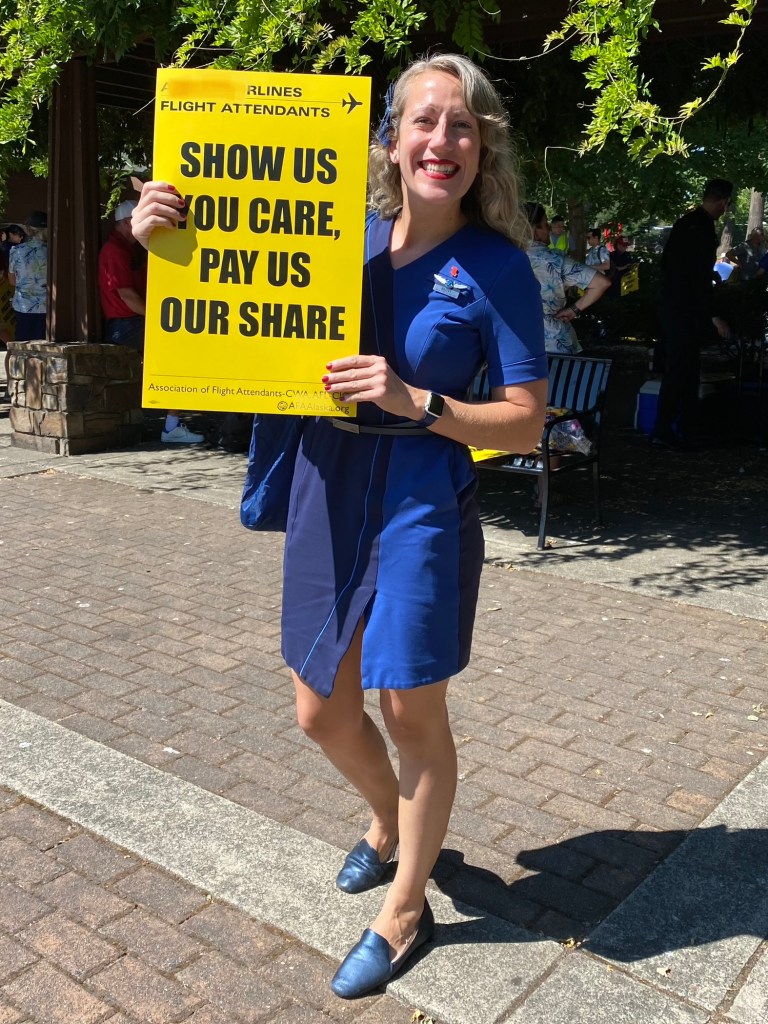
Also: I do not plan to volunteer as tribute for Christmas 2023. Lesson learned.
-
TooGoodToGo: The cheap food app perfect for travelers!

Things I love:
- Good deals.
- Surprises.
- Food.
As a result of these three loves, I am OBSESSED with the app TooGoodToGo. I promise, this is not a paid endorsement. It’s just one of my favorite things to use on a layover.
Basically, it’s an app where you can pay to get leftover food from restaurants, coffee shops, and grocery stores.
It’s amazing for a traveler who wants to try local cuisine but also wants to save money. (ME! It’s MEEEE!)
Basically the app will search by location and tell you what restaurants have “surprise bags” available in the next day or so. Often it will give you some clue of what to expect (such as “bread and pastries,” and you can filter the results to show you only meals, only bread and pastries, or only groceries.
It’s so fun!
Typically you’ll pay about 33% of the regular price for the food you get.
Users can rate their experience, so as a result it’s pretty easy to make sure you have a great experience. I personally try to stick with surprise bags with a rating of 4.5+. I typically get huge amounts of food (typically if it’s a “meal” bag it’s enough for two meals) for $5-6, and it’s good food!
TooGoodToGo is best to use in larger liberal “foodie” cities. (New York, San Francisco, etc). In smaller and more conservative areas you won’t find as many businesses that use ToGoodToGo.
The app is fantastic for flight attendants, with one HUGE caveat: The app uses the time zone that you are in while you’re using it! Twice now I’ve forgotten this, ordered food for the next day while on the west coast, and then been surprised when I got to the east coast and my food wasn’t ready when I thought it would be.
TooGoodToGo is best for people who eat a wide variety of foods and who don’t have dietary restrictions. You can filter for vegetarian options, but I don’t believe there is much for people with allergies or other food sensitivities.
I like to take my TooGoodToGo meals and enjoy them in a nice little local park.
Here’s some examples of recent TooGoodToGo scores:
In Chicago, I got a small pizza, medium Greek salad, and medium fruit salad all for $5. The best part? The park I ate it in had a Chicago Dog kiosk nearby and I noticed that I could have spent $6.50 for ONE hotdog, but I spent less and got a huge amount, good quality, and good variety of food!

In Hoboken, I got two huge Indian meals with rice, lentils/chickpeas, and chicken/beef. In this case, the cashier messed up and accidentally prepared me two boxes when I ordered one, but I sure was happy to get all that for $5!
In New York and New Jersey you can typically get a dozen bagels for $4, and sometimes they’ll even come with a little topping (usually not cream cheese, since it has a good shelf life! Think more like spicy tuna!).

So go…start using the TooGoodToGo app and enjoying fabulous local food at a discounted price!
-
My AirBnB Nightmare

I generally think that AirBnB is great. At some point, I’ll write about why I love AirBnB, but today I’m going to write about my AirBnB nightmare. Here’s how it went down:
I booked an AirBnB near Kuromon Market in Osaka for 3 nights. I was supposed to land at around 10pm at the Osaka Airport, and then the plan was to take the train into the city and walk to the AirBnB. Saign and L were on a different flight, and would not arrive until the next morning.
The problem? Well, there were many.
I noticed before I left the US that the AirBnB host had given me an address and a door code, but hadn’t specified where to look for the door code/lockbox, or specified an apartment number. Since I was landing late at night, I wanted to have this straightened out before I landed. The night before I left for Japan, I sent the host a message asking about the apartment number and where to look for the lockbox. He replied, “Just a moment…” and…nothing else…
I had to wake early for my flight the next morning, so didn’t have time to worry about how to find and access the AirBnB. I hoped that the lockbox was obvious, and hoped that maybe there was only one apartment above the restaurant he had instructed me to go to.
My flying itinerary involved a way-too-short layover in Tokyo. My plane landed late, then taxied for forever, then I had to go through a long customs line, and then take a bus to a different terminal to get on my plane to Osaka.
I missed my flight to Osaka, and would have missed the last flight of the night, except the ticketing agent literally ran with me across the airport to a special super-fast security area.
I made it to Osaka, but it was late at night. I was very aware that I needed to get things done fast, because I knew the trains in Japan don’t run very late, and I was at risk of missing the last train into Osaka. I got a Japanese Sim Card and then successfully navigated buying a train ticket. I went down to the train terminal, and while I was down there, I realized that my sim card wasn’t working. If I hadn’t been at risk of missing the last train into the city, I would have gone back up to the airport terminal to access wifi and figure out how to get my sim card working, but, I couldn’t risk missing the train.
I took the train into Osaka and successfully walked to my AirBnB. The host had previously told me the apartment was above a restaurant, so I was fairly certain I was in the right place, though I couldn’t find a numbered address anywhere. The front door to the apartment complex was open, so I was able to get in, but there were several floors of apartments, so I had no idea where to go (since the host had not provided me with an apartment number). It was midnight, and I was alone, and I had no way to get in touch with the host because my sim card wasn’t working.
I should also mention that my phone was running low on battery. I’m generally very careful about saving battery life when traveling, but I had a long layover in Vancouver, so I used it when out exploring on my layover. The terminal I was in at the Vancouver Airport didn’t seem to have any outlets that worked, and then the plane I flew on did not have any outlets. So…I was nervous about running out of battery in addition to being worried about how to access the internet.
I walked around a bit, trying to find some wifi that was not password protected (but this was a drain on my battery…). I was able to get on wifi and send my host a message explaining that I was locked out and alone and desperate…and then that wifi stopped working.
So I was alone, walking around in a strange city in the dark with all my luggage with me, with no way to contact my AirBnB host.
I cried a little bit.
I went back to the apartment building and found that someone had locked the exterior door that had previously been unlocked, so I was now completely on the streets by myself.
I cried a bit more. I didn’t know what to do!
Suddenly I remembered something: My work phone! I had brought my work phone with me, and since it’s a T-Mobile device, it should work in Japan! We’re discouraged for using it excessively for non-work related purposes, but desperate times…
I turned on my work phone, and found that it worked just fine! I was able to log into AirBnB to find that the host had not responded to my plea for help. I was able to find the AirBnB customer service number. I spoke to an agent at AirBnB who said she’d call the host.
She called. He didn’t answer.
At this point, I pushed for a solution. I pointed out that I was a woman alone in the dark in an unfamiliar city. I pointed out that I had already tried to get ahold of the AirBnB host 2x (once before I left the states, and then 30-or-so-minutes before speaking to the agent). I explained that I was exhausted and needed a solution now. She stated that I could get a hotel and that AirBnB would reimburse me. I asked if she would reimburse me the cost of transportation to the hotel, as the trains were no longer running, so I’d have to take an Uber/taxi, and she stated that only the cost of the room would be reimbursed.
I hung up with her, and looked for a nearby hotel on Google Maps. I found several. The problem? It was now 1am-or-so, so I couldn’t book a hotel for that night! I needed a hotel for 4/14-4/15, but because it was already 4/15, none of the booking sites would let me book for 4/14-15!
I didn’t know what to do. In the end, I decided to walk to the nearest hotel. It was only about a block away, and I found it easily. When I got there, the door was locked, but there was a manager on duty. I waved at the manager and he let me in.
He did not speak English.
I do not speak Japanese.
Using a translator app, I asked him if had a room available.
He stated that he did not.
I was very sad.
But wait! While I was speaking to him, I noticed a display with the hotel’s wifi code! Very useful!
I sat on a bench outside the hotel and logged into the hotel’s wifi. I planned to try to find another hotel.
While I was logging onto the internet, the hotel manager came out and motioned me back in.
I followed him in.
Using his translator app, he explained that he could give me a room for just one night.
I took it!
It was a tiny box of a room, but it had a bed and a shower!

Thank you, Hotel Asiato, for giving me a bed when I was desperate… After my shower, I got a message from the AirBnB host providing me with the apartment number and another door code. I told him that I’d try to access the apartment the next morning, but that I was safely checked into the hotel.
I didn’t sleep much that night, because I was quite adrenaline-filled.
The next morning, I tried again to re-access the AirBnB apartment. It turns out the host had initially given me only the code for the front exterior door. Oh. And the keypad for the exterior door only lights up to show the numbers if you push one particular button; so while I had touched it the night before in my desperation to get in, it never lit up to reveal the numbers.
I looked through my messages, and the host had provided the apartment number with the address at some point…though (he didn’t realize this), the address didn’t translate to English the way he thought it would, so when I looked at it, the address was a series of numbers and then Japanese characters and then numbers and then Japanese characters, etc, such that I could not tell which was the apartment number.
Finally…he had forgotten to give me the door code for the individual apartment that I was staying in! Even if I had figured out which of the numbers was the apartment number, I wouldn’t have gotten in, because I hadn’t received the door code!
Anyway, I did eventually get into the AirBnB. AirBnB did NOT reimburse me for the entire hotel cost, but they reimbursed some of it.
I know some people are scared of AirBnBs and will read this and conclude that one should never stay in an AirBnB. I strongly disagree, and even when I was locked out in the dark, crying, and speaking to the AirBnB agent, I knew that I would definitely 100% use AirBnB again. The host was human. He made an error. The error was worsened by my late arrival and communication challenges. But, I have stayed at many unique and beautiful and also affordable properties with AirBnB, and I will 100% use them again.
I *may* be more careful about making sure check-in instructions and apartment location are clear next time around though!
-
Success! First Time Using Flight Benefits on Another Airline
I’ve explained before that my family and I can fly for free on my airline for domestic flights, and for just taxes on international flights with my airline. My family and I can also fly for discounted prices on most major airlines. As a flight attendant, I have an additional bonus (known as a cabin seat agreement) which allows me to fly free domestically on nearly any carrier, and there are a few carriers that will let me fly for just the taxes on their international flights. (Emphasis on “few,” it’s quite limited!)
Here’s the story of using my flight benefits for the first time on another carrier. It’s extremely detailed and possibly extremely boring, and definitely a bit confusing, but I know a few people will be interested in hearing it. Here goes:
We used airline miles to book flights from Seattle to Osaka, Japan in March. We also used airline miles to book flights for Saign and L from Tokyo back to the US in April. We decided NOT to book a flight back to the US for me because I wanted to try and see if I could fly back to the US for just the taxes.
Here’s what it looked like:
In March, I started looking at flight options and came up with a strategy. Here’s the strategy I came up with:
Plan A: Use the Cabin Seat Agreement to get to the US…anywhere in the US…on 4/13. (This left me with 5 flights I could try for…one which flew directly to Seattle). If Plan A worked, I’d have to pay just the taxes for my flight. (This would cost <$50)
Plan B: List for Standby and pay for a direct flight to Seattle on another carrier (not through the Cabin Seat Agreement, but through regular airline employee benefits) that leaves on 4/13 AFTER the 5 flights that fit my Plan A. (This would cost $150)
Plan C: List for standby and pay for flights on any carrier to the West Coast for 4/14. Perhaps list for a whole bunch so that you can make sure to get home! (Depending on the airline and class, this could cost between $125-300).
I knew from the beginning that I’d hope to only have to fly using Plan A, but I’d follow through with listing per Plan B. I had to complete my listing per Plan B prior to leaving the US for Japan, because there was a risk they wouldn’t let me into the country if I didn’t have an outgoing flight booked. (When listing for standby travel, all but a few dollars are always refundable if you don’t end up flying with the airline you listed with).
As it got closer to 4/13, I started requesting flight loads from employees at other airlines so that I could list for more flights (per Plan C) if needed. The flight loads looked a bit nasty, with minimal seats open, and lots of people listed. But I was so overwhelmed with all the options that I decided to just wait to list for flights on 4/14 (for Plan C). The carrier that I could accomplish Plan A with does not release their flight loads to employees until 72 hours in advance, so I was learning about flight loads on other carriers before I could learn about flight loads for my Plan A flights. Most carriers require you to list 24 hours in advance, so there was some risk to not listing on these other carriers, but I was just overwhelmed!
On 4/11, I got some great news: The tax-only flights (Plan A) were looking a lot more open on 4/13 than the other flights! GREAT! There was a flight to Detroit that had 100 open seats! (While this was generally good news, sometimes there are weight and balance restrictions, so they wont put standby passengers on even if there are open seats, plus if another flight to the US cancelled, that flight to Detroit could get filled up quickly).
I had been told that outside of the US, ticket agents often are confused by the Cabin Seat Agreement (Plan A), so it’s best to arrive early to the airport, and to be ready to stand firm and communicate clearly about how it should work. (This was a bit intimidating since I had never used the Cabin Seat Agreement or flown standby with another carrier before).
I got to the airport 3 hours before the Detroit flight. I went to the ticket counter. As I had been warned about, they were confused. They told me to go to the check-in desk. I knew (per the written policy) that this was incorrect, and I was supposed to go to the ticketing counter, not the check-in desk, and I let the agent at the ticket counter know this, but then complied and went to the check-in counter. I waited in line for several minutes, and then ticket-counter-guy came and got me out of line and told me he’d “try” to figure out how to list me using the Cabin Seat Agreement.
And try he did…to the point that a line formed behind me. I politely suggested he take care of those guests and come back to me. He refused at first, and called a friend over to help him. Then they both tried to get me listed. The line grew longer. Finally, they had me move to the side so that they could help the other guests. But, after maybe 30 minutes, they had a ticket for me! Yay!
But then I looked. The ticket said, “jumpseat.” I’m not allowed to sit on the jumpseat on this airline. I had to go back and say, “You need to “flow me back’” to the cabin. (Again, this was verbage I had learned from studying the Cabin Seat Agreement). Thankfully, the agent knew what I was talking about, and gave me a “seat request” ticket. She told me to head to the gates. Yay!
There were no agents yet at the gates when I got to them, so I had to wait a bit. When the agents finally arrived, I went to speak to them to make sure I understood the process.
Me: “Hi! I’m flying standby. I just wanted to make sure I know what to expect. Will you be calling my name?”
Agent: “No. You have to wait.”
Me: ??
Agent: “When the crew arrives, we have to ask the captain.”
Me: “…but then will you call my name???”
So at this point, I was concerned that things might go awry as things were clearly getting lost in translation. So what did I decide to do? Watch for the captain and see if I had an opportunity to speak to him myself.
(To be clear: This is ridiculous. I am ridiculous. But I really didn’t want to get stuck sitting at the airport overnight, so I was prepared to be a weirdo if it increased my chances of getting on the flight.)
A First Officer arrived was standing by the gate, and I consider speaking to him, but I decide that talking to him by himself would be weird. Nope. I waited until the whole crew arrived, including the captain. Then I walked up and said, “Hi! I’m Becky. I’m a Seattle-based flight attendant with _______. I just came to introduce myself because I’m trying to use the Cabin Seat Agreement to get home, and the agent said she’d have to ask the captain. That sounds strange, but just in case, I came to introduce myself.” The crew was nice to me despite my awkwardness, and the First Officer assured me I’d get on and that there were no weight and balance restrictions.
Then I waited more!
I heard them start calling names, but I didn’t hear mine. After awhile, as boarding was winding down, I stood next to the other standby passengers, waiting for my name. As I chatted with them, I figured out that I would be the very last one called. When you use the Cabin Seat Agreement, you’re the lowest priority, and there was one other flight attendant using the agreement, but she was hired before me, so I knew I’d be last to be called. And…I was!
But, I was so happy when they handed me that boarding pass. Then I got on the plane, and found I was in Comfort+ (so a few extra inches of legroom) in an aisle seat with an open seat next to me! They did try to give me a nice place to sit!
The flight to Detroit went as well as a 12 hour flight can go.
As we got into Detroit, I looked at the flight options. My airline had plenty of seats available 4 hours later, but there was another carrier that I could try to fly home on for free (again, with the Cabin Seat Agreement). I went to the gate and asked if I’d be able to get on. The agent told me he couldn’t get me on, so I told him I’d sit by the gate just in case.
At the end of boarding, he had 1 seat left. He called over the couple who were at the top of the standby list. They didn’t want to separate!
He called the next couple on the list. They didn’t arrive!
He listed me for the flight, and gave me the boarding pass, telling me he might have to pull me off if the other people arrived. “Of course,” I told him, thanking him for all his help.
And then I was flying home several hours sooner than I would have been able to if I had waited to fly with my airline! 🙂
22 hours after I arrived at the Tokyo aiport, I was home at Seatac!
Was it a hassle? Yes! Did Saign and L fly home directly to Seatac on an 8 hour flight? Yes! Could it have been way worse? Yes, WAAAAAAY worse!
Total cost for the flight to the US? $47.33.
And it gets better…taxes are only charged on the way into the US, so if I had used the Cabin Seat Agreement round-trip, it still would have been just $47.33
I LOVE BEING A FLIGHT ATTENDANT!
(It did REALLY REALLY make me want to work for an international airline so that my family could also get all these benefits!)
-
One Year as a Flight Attendant

About two weeks ago, I hit my one year anniversary as a flight attendant!
Let’s talk about it.
Can you imagine wanting to go to work?
I know! That’s a crazy thought, isn’t it?
In all seriousness, I hope that many people do look forward to going to work. Towards the end of my career as a psychologist, it had been years since I looked forward to going to work. For many years, work vacillated between being tolerable on a good day, and frustrating on a bad day. During the last two years as a psychologist, it was rarely tolerable, and generally I was miserable. I dreaded work.
Now that I’m a flight attendant, I generally don’t mind going to work. Often, I really look forward to it! Sometimes I get shifts that I don’t like (redeyes, or lots of legs in a day), but even on those days, I don’t usually dread it. I feel mildly annoyed, and then I go to work, and it’s fine.
I’m so much happier now in this new career! I’m so much more relaxed.
There have been a few times that I miss being a psychologist. Once, I saw one of my old patients running around with classmates at a park. The year prior, the child had struggled to attend school and struggled to make friends. We worked really hard to get them into a school program that would work for them and to keep trying to make friends. I was so proud to see them out and about and acting like a child! In that moment, I remembered the joy of celebrating with my patients when they did hard things. I missed celebrating with kids and teens when they followed recommendations and did things they didn’t think they were capable of.
There have also been a few times when either a conversation related to medicine or mental health took place, or I was doing Continuing Education, and I felt a little bit of regret or loss remembering how good I was at being a psychologist. I was really good at it. There is some regret associated with knowing that there is so much mental health need, and I can help, but I’m choosing not to.
There are also times when I suddenly think, “Have I made a terrible mistake???” because of finances. At first being a flight attendant was financially scary because I went from saving over half my income to making <1/3rd of my previous income. It’s scary going from saving mode to barely making ends meet. Except, in reality I was not barely making ends meet, it just felt like I was barely making ends meet because I was making very little money, so Saign had to pay a larger portion of the bills. Saign was making enough that we were still able to save into our HSAs, our Roths, and our 401ks (though I did not max out the 401k like I normally would). I had to keep reminding myself that we were okay, and even with a drastic reduction in savings rate, we were still saving more than most people. And then, a couple months ago, Saign had to stop working due to a shoulder injury. He had surgery in February, but still can’t work right now (in April). We have Emergency Savings for situations just like this, but it feels really, really icky using our Emergency Savings (in reality, we’ve only touched a couple thousand of it and that was so that he could max out his 401k, so seriously, we’re okay). But it feels scary. So sometimes I get a gross feeling in the pit of my stomach and worry I’m doing things wrong.
But…I’m so happy.
This job makes me happy. If I don’t work for long enough, I start getting antsy to get back to work.
It’s amazing!
Aaaaandddd. This job fits our future goals. Saign and I love travel. We’d love a future where we can spend a few months overseas and then a few months back in the US. Unless one of us got an online job, this would be really hard. (Mostly because even if we saved enough money to live off of so that we didn’t have to work, paying for health insurance in the US is cost prohibitive). The work rules with my company are such that we could come back and forth in and out of the US like we want to. I could fly back to the US to work if needed, and I could take a month off and still keep health insurance. This fits our future goals.
So…it’s been a wonderful year! Despite sometimes feeling regret or worry, I’m so so happy that I made the switch! I was recently listening to a podcast where a career coach pointed out that you should make a career switch if you know that if you stay at your current job, there’s a 100% chance that you’ll be unhappy. Maybe the new job will not make you happy either, but you’ve got nothing to lose if you’re already unhappy and confident that you’ll continue to be unhappy! I’m so glad I took this advice before I’d even heard it! Cheers to The Great Resignation! Cheers to one year as a flight attendant!

-
How to Fly Around the World and NOT Break the Bank

I am an incredibly frugal person. I think sometimes people look at my life and may think that I live a life of deprivation and that I miss out. I’m sure sometimes it’s true that I’ve really missed out on something amazing because I didn’t want to spend money. But MOST of the time, I don’t feel that I miss out, because my goal is not to hold onto money at all costs; My goal is to spend money on the things that really matter.
In our family, that means the thing we most splurge on is TRAVEL! To us, travel is what is worth the cost!
And though travel is truly our main splurge, I’ve realized that people sometimes get it twisted when it comes to how much travel really costs. I’ve decided to write a bit about how to save money on travel. This will be a multi-part series, and it starts today with how to save money on airfare. I’d say I’m pretty awesome at saving money on airfare, so today I’m going to share some of my tips and tricks:
- Let airfare price dictate where and when you go. It seems that most people pick a destination first and then buy their airfare, which I suppose makes sense if money is of no concern to you. But if you want to save money, you should really look at airfare before choosing where to go. Instead of choosing a destination and then shopping for airfare, we watch for good flight deals, and then when we see them, we think, “Hey! Yeah! That seems like a cool place to go! Let’s go there; it’s cheap right now!” What this means is that we typically pay around $400 for round trip European flights, and slightly more for Asia/Africa/the South Pacific ($500-$600). If you’re American, you can be super impulsive with your airline ticket purchase, because by law airlines must refund you your money or miles if you change your mind within 24 hours of booking! This makes it extra easy to book a good deal right when you see it, because you can always cancel if you realize the dates won’t work. (I often find deals while Saign is sleeping, book them, and then tell him about them in the morning).
- Fly Open Jaw. “Open Jaw” means that you fly into one airport and out of another. This can save you both time and money, depending on your destination. As a family, we don’t always fly open jaw. We do it when it makes sense. It makes sense to do fly open jaw if you can save money because the airfare happens to be cheaper out of a different airport than you flew into. (For example, London, England has 3 airports. Sometimes it’s cheapest to fly into Heathrow but out of Gatwick). To make sure you get the best deal in these circumstances, you can tell your booking site to search “London Area” airports, and then it will search all the airports in the region. Flying open jaw can also save you time and money if you know you want to see a lot of one country/region. For example, we traveled by campervan in Australia several years ago, so we flew into Melbourne and out of Brisbane. If we had driven all the way back down to Melbourne to fly back out, it would have cost us a great deal of money in petrol, and a great deal of time doing all that driving! Flying open jaw doesn’t always make sense, but it’s certainly best to consider where you want to go and what you want to see to determine if open jaw flying will save you money.
- Utilize flight saver emails. If you decide to use principle #1, then signing up for a subscription site that sends you flight deals is often a great idea. My favorite of these is Going (formerly Scott’s Cheap Flights). Basically you tell the website what airports you like to fly out of, and they email you when amazing flight deals come up. It makes it easy to know when there’s a great deal. Going has a free service and two tiers of paid service. Our family has found great flight deals from Going with both the free subscription and the lower tier paid subscription.
- Google Flights is your friend! Y’all, if you haven’t used Google Flights yet, you must check it out! The website’s “explore” feature allows you to type in your starting point and then either put in a time period and/or a length of time (unfortunately it’s limited to 1 week or 2 weeks), and then you can look at a map and it will highlight the best deals that fit your parameters. My favorite is to say “two weeks in the next 6 months” and find good deals that way!
- Be open to layovers. Yes, I will suffer to get to a destination. Now if it’s only, say $50 more to get a direct international flight, I’ll do it. But otherwise, I go for the cheapest flight, even if it means I have lots of flights to get to my destination. Sometimes this can be fun! I once spent my birthday at a 200 year old brewery in Munich on a layover on my way to South Africa. My only time in South Korea has been on a long layover in which we took the train into the city and enjoyed a market. A lot of times the cheapest route take you on a weird roundabout adventure to get to your destination, but it’s worth it! (I know many people will disagree with me on this point, but I stand by my opinion!)
- Use those credit card rewards! So, while I strongly believe that principle #1 is the BEST advice I can give anyone on how to fly on the cheap, there are limitations to using principle #1. Certain destinations rarely go very low in price. There are several destinations that I’d love to visit, but have missed out on because I’ve never seen a really great flight deal. Japan, Argentina, Chile are all places I’d love to visit, but have not yet been to because I’ve never seen low prices on flights to these places. The solution? Credit card rewards! With US carriers, 60,000 miles is often enough to book a round trip ticket to an international destination in coach, and often credit card bonuses are 60,000 miles +. My family is finally going to Japan this year, and we’re using miles to get there! I would urge anyone looking to be thoughtful about how they spend their miles. In my opinion, miles are best spent on destinations that are typically costlier to fly to.
- Stay longer. Okay, this is less about paying less for flights, and more about getting bang-for-your-buck when it comes to airfare. If you’re paying a lot of money to fly around the world, you might as well make it worth it! In our family we aim to make sure our vacations are 3 weeks + to really make that airfare cost worth it.
- Make it a work trip. If your work will pay for conferences or other learning activities, consider if you can make it a vacation! One of Saign’s favorite vacations was to Mallorca, Spain. I went to a conference for a few days while I was there, so the hospital I worked for paid for my airfare to and from Mallorca as well as the AirBnB and my meals for the days that we were in Mallorca. We spent a few weeks in Spain in addition to the few days I spent at the conference, but my costs during the Mallorca portion of the trip were paid by my employer.
- Become a flight attendant. I’ve written a little about non-revenue benefits before, but here’s basically how they work: Airline employees and their families get free standby travel on domestic flights with their own carrier. Airline employees and their families pay just the taxes on international travel with our own carrier. We get discounted tickets on standby travel with other airlines. Flight attendants specifically get a little bit of a better deal than standard airline employees on other airlines: On certain airlines, we can pay just the taxes for flying. If recommendations 1-8 don’t work for you, come on over to what I have deemed the best job in the world…as long as you don’t need a job!
So there you are: Nine ways that my family flies the world on the cheap!

-
Subscribe
Subscribed
Already have a WordPress.com account? Log in now.
 Adventure Fam