-
Taking one for the team.
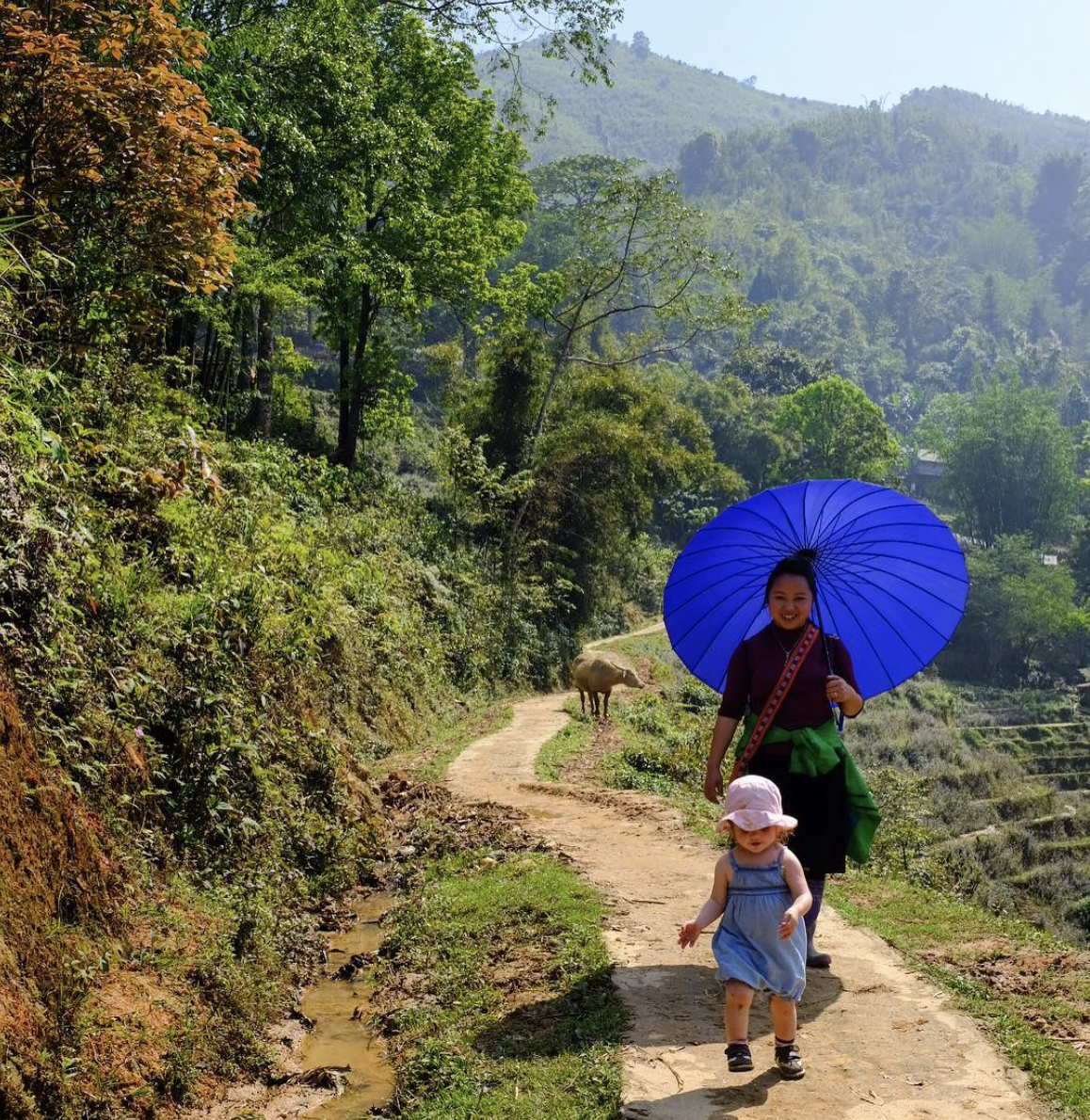
So when L was around 20 months old, we had a trip planned to Vietnam.
The only problem? Saign was having a ton of back pain. He got an MRI which showed a herniated disc, but he couldn’t get in to see the back-doctor-guy until after our trip. He told me he wasn’t sure he wanted to go on the trip. To me this didn’t make sense: He could be in pain at home (lame) or be in pain in Vietnam (less lame). But he was worried that the flight would set him back and make his back pain worse, so he told me he wasn’t sure that he wanted to go on the trip to Vietnam.
I called in a favor to a sports medicine doctor, who squeezed him in 2 days before our trip. I just wanted him to give Saign an opinion on if the flight would really make things worse for him, because I truly believed that Saign would be happier recovering in Vietnam vs recovering at home.
Saign came back from the doctor and said, “Well, he said that if I go, I’ll really be taking one for the team.”
TAKING ONE FOR THE TEAM?
TAKING ONE FOR THE TEAM?
What kind of a delusional world was this man living in? And seriously, just what Saign needs, a doctor stroking his ego.
Saign soaked it up. He looooooooved the idea that he’d be so selfless and “taking one for the team” by traveling with us to Vietnam. He repeated it over and over to me, to our friends, and I’m sure in his head as well.
Now, let me tell you the reality: Did I want Saign to go on this trip? Yes. Was it because it would HELP me? No! Are you kidding me? I’m perfectly comfortable traveling alone with my child. I wanted Saign to come to Vietnam because I thought he’d be happier in Vietnam. But would it be helpful to me? Absolutely not. (He couldn’t carry the kid or the luggage, and he doesn’t do any of the planning or research, so without his brute strength – which he didn’t have because of the back pain – , he really would not be of much use to me).
Saign did decide to come to Vietnam, and the flight over didn’t set back his recovery, and he got better and better every day.
I had planned a 2 day trek in Sapa about a week after arriving in Vietnam. I wasn’t sure if Saign would feel up to coming on the trek with me. When I originally planned it, I imagined that one of us would carry our clothes and necessities, and the other would carry L. The trek involved hiking for several hours through rice fields and hills for two days in a row. When I asked Saign if he planned to come to Sapa, he said he didn’t want to go. Since he was getting better and would be staying in Hanoi with air conditioning and no particular plan, and I was going to be hiking around miles of rice fields in the heat, I asked him if he would take L. You know, so he could “take one for the team.” He absolutely refused and acted as if I was insane for asking. He said he needed to rest and recover and that taking care of L would prevent him from doing so.
Ah, Taking one for the team!
On the night that the trip to Sapa was to begin, L and I got in a taxi and took it to a bus station to head to Sapa for an overnight bus trip. The bus would take 6 hours. L fell asleep in the taxi. I got onto the overnight bus where I was told I’d have a bed to sleep on. Unfortunately, the reality was that the “bed” was like a tiny tight coffin. AND I had a toddler with me, so I had to keep toys and snacks plus the toddler in the coffin with me.
L woke up when I tried to squeeze into the coffin on the bus. After that, she refused to lie down and go to sleep. We were crowded and uncomfortable in our little bus coffin. I remember she kept standing up and then belly flopping onto me instead of sleeping. At around 2am, utterly exhausted, L started crying, waking up the whole bus. I was mortified.
The bus arrived in Sapa at 3am and L was still crying. We were allowed to stay on the bus to sleep until morning, but since my child was disturbing everyone around us, I got off and wandered around Sapa in the dark. Thankfully, the bus station was open so once L quieted, I went in the station and attempted to sleep on a plastic chair. I did not sleep, but thankfully L did.
Later that morning, after having not slept at all, I met my guide and hiked for miles through rice fields in the heat with L on my back and our clothes and necessities strapped to me. It was a slog. I worthwhile slog, but still definitely a slog.

We arrived at our host home after our first day of hiking, and there was nothing for L to play with or do. (I certainly hadn’t been able to pack toys with me in addition to our clothes, necessities, and L…in fact, I PURPOSELY left my toothbrush in Sapa city to reduce the load that I had to carry…though I went on to regret that choice…). At dinner, L fell off a chair and onto a concrete floor, breaking the chair in the process. I was reprimanded for allowing her on the chair. She ended up playing with beer bottles because it was the only thing there for her to play with.
Meanwhile, Saign wandered around Hanoi and met some strangers who first invited him to eat and drink with them and then invited him to karaoke. While at karaoke, the men he was hanging out with asked him which of the karaoke hostesses he preferred. At first Saign didn’t understand why they were asking him this. Then he noticed his new friends were leaving with the female hosts one at a time. Yes, it turned out he was at a brothel. You know, a karaoke brothel.
So yes, Saign really took one for the team! What would our team have done if he hadn’t made it to the karaoke brothel that day? What a travesty that would have been.
-
Tips for Flying with a Newborn
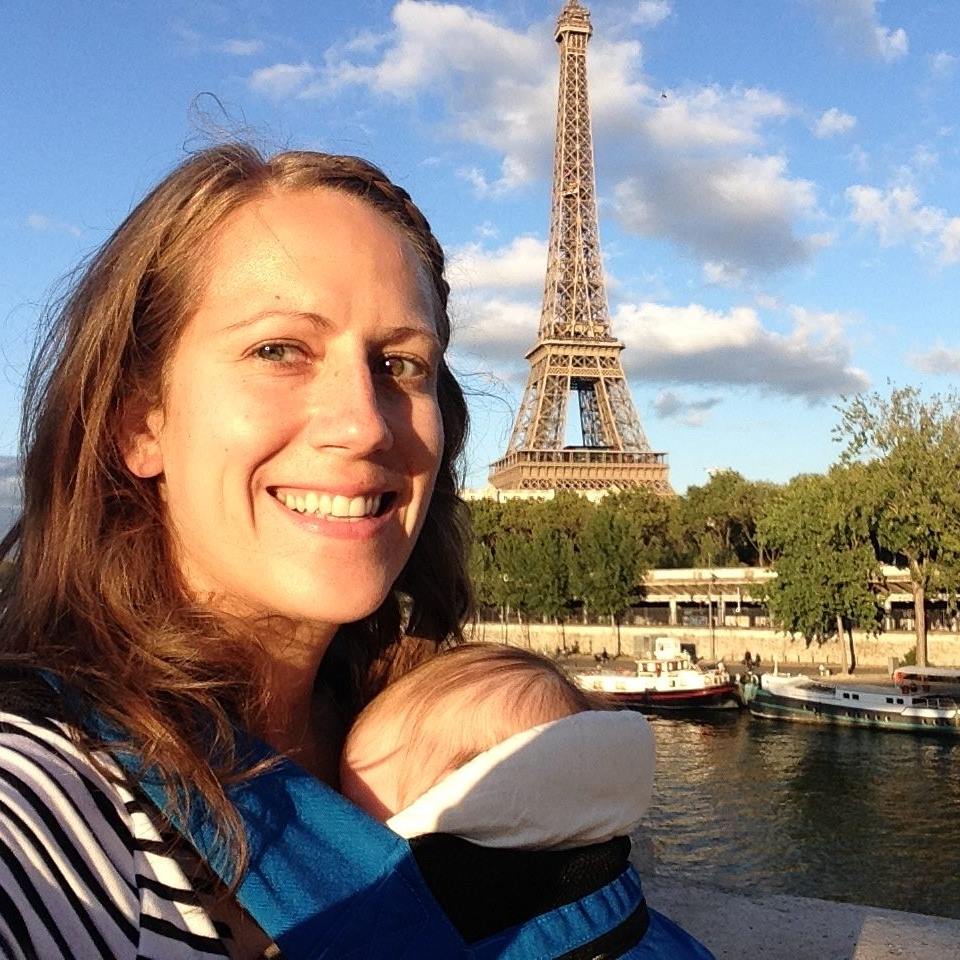
Okay, let’s just start this off with the truth: I am no expert on flying with a newborn (meaning a baby who is under 3 months). I flew with my child as a newborn for a total of 21 hours, and a total of 4 flights: Seattle to Reykjavik, Reykjavik to Paris, and back along the same route. Buuuut, after each flight I had people turn to me in shock and say, “I didn’t know there was a baby on this flight!” So I’ve got a few tips of what worked for me. Here they are:
- Consider your baby’s temperament to decide if it’s worth it. I started plotting to go on an international trip with my newborn while I was pregnant, but I didn’t book the trip until she was born. Why? Some newborns are fussy and really challenging. I planned to travel with my newborn only if her temperament was average-to-easy. A colicky baby with 21+ hours of flying for a one week trip would not be worth it for me.
- Stick with a feeding schedule. In normal life, I would wait for L to cry or fuss to let me know that she was hungry. On a plane, I didn’t want her disturbing the other passengers. I kept her on an eating schedule, meaning that I fed her every 2 hours while awake, and every 2.5 hours if she was asleep. If she was sleeping, I’d wake her by sticking my boob in her mouth. She’d eat and fall back to sleep. With a feeding schedule, she didn’t get hungry, and therefore didn’t get upset, and didn’t cry at all. (I breastfed, which made this particularly easy, but I have lots of experience taking care of bottle-fed babies, and feel this would work fine with bottles as well, though).
- Use cloth diaper covers. I’ll never forget our first trip with L. She was 5 weeks old and we took her to Walla Walla, WA. We were at a beautiful vineyard sipping wine when suddenly I felt something warm on my leg. It was a poo-splosion. I was horrified. I had never experienced this before (and hadn’t packed enough clothes for this problem!). The reason it had never happened before? We cloth diapered when we weren’t traveling. Cloth diapers don’t leak the way disposables do. At the time, I already had our tickets to Paris booked and I was SUPER stressed about having a poo-splosion on a plane while alone with my newborn (but obviously wasn’t going to cloth diaper her on a plane or in Paris). Finally I came up with my most brilliant newborn travel hack: Cloth diaper covers! Basically they’re the plastic shells that are snapped around the cloth part of the diaper for people who use the old methods of cloth diapering. BUT they can also be easily snapped around a disposable diaper to keep things contained when using disposable diapers, which is what I always did while traveling with L when she was still wearing diapers. Seriously, if you listen to nothing else in this post, this is the one to follow!
- Use an infant carrier (Like a moby or a lillebaby or an ergo – But not while taking off and landing). I will admit, I’m pretty biased about carriers generally; unless you have a kid who hates being held, carriers make life as a parent so much easier. As a flight attendant I’m always shocked by the parents who struggle to get themselves and their babies on the plane because they’re trying to carry both their baby and their luggage with their hands! Carriers mean you can have 2 hands available for use while carrying your baby! On a long flight, carriers are even better because you will probably be tired. Can you imagine accidentally drifting off to sleep while on an 8 hour flight? Yep, it would be easy to do! But what if you were holding your baby while you fell asleep? You might drop them! Carriers are great once at cruising altitude. You can also eat, go to the bathroom, etc while “holding” your baby in the carrier. I found wrap carriers to be most comfortable while in flight, but soft-sided carriers are generally best for all other travel contexts (like airports, walking around cities) I actually brought both a Moby and an Ergo with me when I went to Paris because I wanted the Moby for the plane and the Ergo for sightseeing.
- Wear a nursing shirt and nursing bra if nursing while flying. I’ve been stuck in a middle seat in Economy with a nursing lap infant between two men before. It’s awkward. But, wearing a nursing shirt meant I didn’t have to pull my breast out in front of strangers, and meant that I didn’t have to pull my shirt up to show my tummy. It was still super awkward and uncomfortable, but much less so than if I hadn’t been wearing a nursing top/bra.
- Go in with a plan. Parents are often quite anxious about traveling with their newborns. I’d encourage you to think through the phases of travel and the specific concerns you have for each phase, and then plan for them. I was worried my baby would cry and disturb others, so I planned a feeding schedule to keep her calm. I was worried my baby would poo all over me, so I brought extra clothes and used cloth diaper covers. You should recognize that delays are possible and bring enough supplies (diapers, formula, bottles, etc) to last well-beyond the hours you think you’ll be on the plane. You should think through your feeding options and have a plan. (Sometimes parents think there are microwaves onboard aircraft; there are not. Basically you can have hot water; that is your main option. If you need hot water to warm a bottle that’s already filled, you’ll need to provide a container to put the hot water in…) Just go in with a plan, and you’ll do okay!
- Remind yourself that it’s okay! I found that there were two main types of people I’d interact with while traveling with a newborn: People who were SUPER nice, or people who were SUPER rude. In either case, I didn’t have to worry about them. The nice people would give me grace, and the rude people didn’t deserve my kindness or respect, so I didn’t worry too much if my baby was bothering them.
I personally feel that traveling with a newborn is at least 10x easier than flying with an infant or toddler, and it was super enjoyable! Get out there, and go!
-
The Best Job in the World…as long as you don’t need a job…
The title says it all. In my opinion, being a flight attendant is absolutely the best job in the world. It is super easy and super fun most of the time. Buuuuuut…it’s not a great way to make money, thus making it the best job in the world only if you don’t need a job.
I think this is important to discuss. I’ve had many people reach out to me to ask me questions about how to become a flight attendant, or to tell me that they’re considering this as a future job. When I explain the financial piece to them, most of them realize that this job cannot work for them. You see, flight attendants make very little money, at least at first. Here are a few contributing factors of why flight attendants make so little money, followed by the main reason (in bold) that flight attendants make so little money:
The hourly wage is pretty low. Unless a flight attendant has been at the same airline for 10+ years, their hourly wage is pretty low. (At my airline, the top-out pay is still less than I was making before becoming a flight attendant). The pay at it’s base is not great.
There’s no negotiating the wage. The wage is set in the contract and no matter what experience you have or how fantastic you are, you’ll get paid the same as everyone else at your seniority level.
Flight attendants don’t work full time hours. This is related to a technicality which I’ll explain below, but I think a lot of people look at the hourly wage and think, “Okay, that should be fine…” not realizing that most flight attendants work 70-90 hours per month. They’ll multiply the hourly wage by the 160 hours they’d work at a traditional job and then be WAY off on how much to reasonably expect they’ll make.
Flight attendants are not paid for their work. Ouch. This is the big one. Most airlines in the US pay their flight attendants only when they’re actually flying. There are two airlines that pay by mileage flown (which basically works out to be the same as only getting paid only while flying). So while basically every airline demands that flight attendants be at the airport 60-90 minutes before their first flight of the sequence will take off, flight attendants are not paid for those 60-90 minutes (with the exception of Delta, who pay their flight attendants half their hourly wage for boarding; though that still leaves time that Delta flight attendants are required to be at the airport but not getting paid, since they have to be at the airport before boarding begins).
The problem compounds though, because often flight attendants are stuck at airports several times per day…while not getting paid to be there. We always have that first hour when we’re reporting for a trip that we’re not paid for. Then we fly somewhere. If we’re lucky, we fly far far away and don’t have to work anymore that day. Buuuuut often enough, we have more flights that same day…and once again we’re not paid when we’re at the airport…usually. My airline pays us for one hour IF we’re stuck at an airport between flights for 2-or-more hours, and as far as my understanding goes, we’re the exception. Most airlines pay their flight attendants nothing for time at the airport.
What this all means is that often flight attendants have HOURS each day they’re working that they’re not paid for working. Boarding is 100% the most stressful part of the job…and we’re not paid for boarding.
You may be asking, “How is this legal?” Yes. Legitimate question. Apparently it relates to some antiquated law called the “Railway Act” or something??? Honestly, it should be illegal, but it’s not.
This is the ugly underside of this super fun job! Because the job is fun and is glamorized, airlines generally aren’t having a hard time hiring, and therefore I’m not optimistic that more ethical pay rules will come into place any time soon.
For me, it’s 100% worth it, but I’m lucky to have worked my way into a financial situation where it’s feasible. I did have a dream the other day that Saign wanted to divorce me, and I woke up and thought, “Holy crap! I need to keep my psychologist’s license! I can’t pay my bills if Saign leaves me!!!” Not a great feeling…
-
The Perfect Layover

I’m often asked, “What’s been your favorite layover?”
My answer to my question is honest, but likely disappointing to the asker, “Any layover that’s over 24 hours.”
Generally, that’s true. I usually have great fun on 24 hour layovers, and no single layover stands out above the rest. (I think Kona probably had the potential to stand out above the rest, but I was ill for most of that layover, so it didn’t really shine like it could have!) However, on those 24 hour layovers, it tends to be less about where I am, and more about finding a balance to how I spend my time that will turn a good layover into a great one.

I just had what I would consider the perfectly layover in Baltimore. Here were the factors:
- 24 hours. Yes, the key to a perfect layover is having at least 24 hours to have fun.
- In the city/near a point of interest. Most of the time my company puts us in the middle of the city so that we can explore when we have longer layovers. But sometimes they put us quite a bit outside the city, which means that I have to figure out a way into the city and waste a lot of time getting from the hotel to the city. This perfect layover had me in a great area in the city so I didn’t have to waste time riding in/out of the city.
- Activities. For me the perfect layover will have a balance of solo activities and activities with others. I’ll tell you about the perfect balance of activities below.
Here are the activities that were important to me on my recent trip to Baltimore (And what generally matters on a layover):
- Exercise. I ran 11 miles (5 miles one day, 6 the next). I would have liked to lift weights, but the hotel gym was locked and even the staff couldn’t get into the gym when I asked! (However, I would have missed out on activity #2 if I had been lifting weights, so I guess it worked out for me).
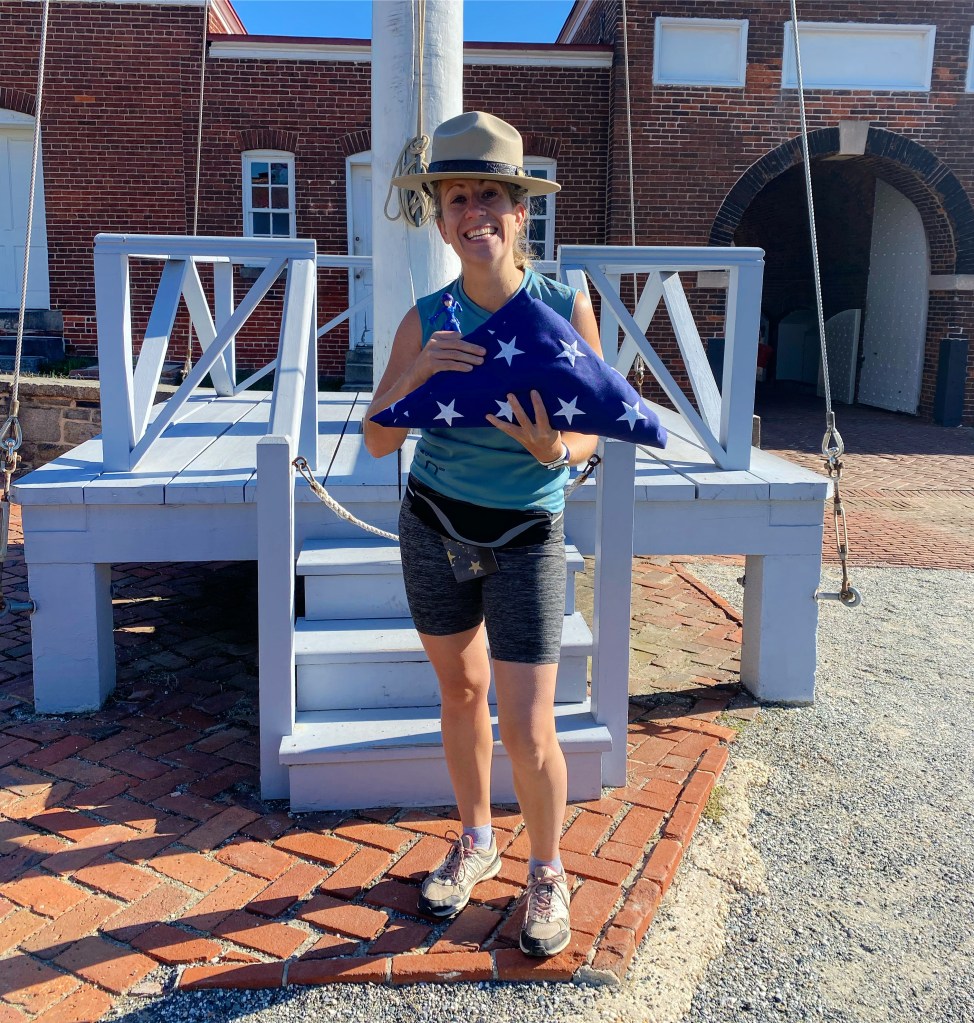
- Community Activities. I loooooove finding free community activities to participate in while on layover. Most often, I go to free concerts (I assume those will be less frequent as we enter fall and winter), but there have also been parades, outdoor movies, etc. In Baltimore, I ran down to Fort McHenry, which commemorates the writing of the star spangled banner. I made it in time to participate in a flag raising ceremony in which we lowered the modern day flag and hoisted the 15 stars 15 stripes flag that would have been what Francis Scott Key saw when he wrote The Star Spangled Banner. It was super cool! The ranger did a great job teaching us about the history!
- Time with an Old Friend. My FAVORITE thing about traveling around North America is getting to see old friends! A huge thank you to my friend, Matt, who came to see me!
- Time with my Crew. I typically enjoy hanging out with my crew as long as I get some alone time as well, and as long as I don’t have to spend too much money. I had a great crew on this trip and enjoyed a chat and a beer with the three other flight attendants in our hotel bar.
- Time to Explore on my Own. I’ve begun to realize that while I’m extremely extroverted and love being around people, I feel like I miss out on the experience of really getting to know a city when I don’t get to explore it at least a bit on my own. When I’m with others, I get distracted with conversation so I don’t truly still enough to soak in the city, or won’t want to make them stop to take pictures or see the things I’m interested in. I really like getting to wander and explore on my own!
- Watching Naked and Afraid. This is my new TV obsession. I never get to watch it at home (we don’t have cable or streaming services), and most of our layover hotels don’t have the Discovery Channel, so I’m always pretty stoked when I get to watch an episode or two!

So there you have it, the perfectly balanced layover. Some old friends, some new friends, some exercise time, some exploration time, and of course, Naked and Afraid.
-
Reserve Life: Getting Paid to Sit Around?

September was a weird month on reserve. My airline increased the number of flight attendants on reserve, which resulted in a lot of us working very little.
As I reviewed here, being “on reserve” means being on-call for the airline. 18 days a month they can call me and make me work. They will pay me as if I worked 90 hours regardless of whether I do or not. My first two months I (by my own choice) went over those 90 hours. These past two months, I’ve been trying to self-assign good trips if any are available, but not trying to work just for the sake of working. Unfortunately, this month, it’s been really hard to self assign any trips.
I worked a total of 10 days in September. Two days were airport standby (meaning I sat at the airport for 5 hours in case they needed me last minute). Two days were turns (meaning I flew somewhere and back in the same day), and 6 days were 2-day trips.

Me in Sitka, AK. One of my 3 trips in September. It rained. A lot. Y’all. I LIKE trips. I like going places and seeing new things.
I realize that probably most people would think that it’s cool to sit at home and get paid to not work. Unfortunately, I don’t love it. I LOOOOOOVE not working when I can camp, hike, or travel. Unfortunately, while on reserve, I have to be able to report to the airport in uniform and ready to work within 2 hours. This leaves me a bit trapped. I can’t even go on a long run when I’m on call! I run these bizarre loops throughout the neighborhood, never straying more than 15 minutes from my house.
Wow.
What a whiner I am.
Don’t get me wrong.
I am happy! This is the best, most fun job in the world!
I just need to tweak how I spend my days when I’m on-call.
I need to do better at packing my bag and being ready to report to work whilst going out and having fun. I don’t have a strategy worked out yet, but I’ve moved from pre-contemplation to contemplation here, so I’m making progress. (That was a psychology joke. I’m still a licensed psychologist; my jokes are as close as I’m planning to get to clinical work).
It IS pretty cool to have a job that’s so fun that I’m actually whining about not getting to work enough. What a privilege!
-
Them Flight Bennies
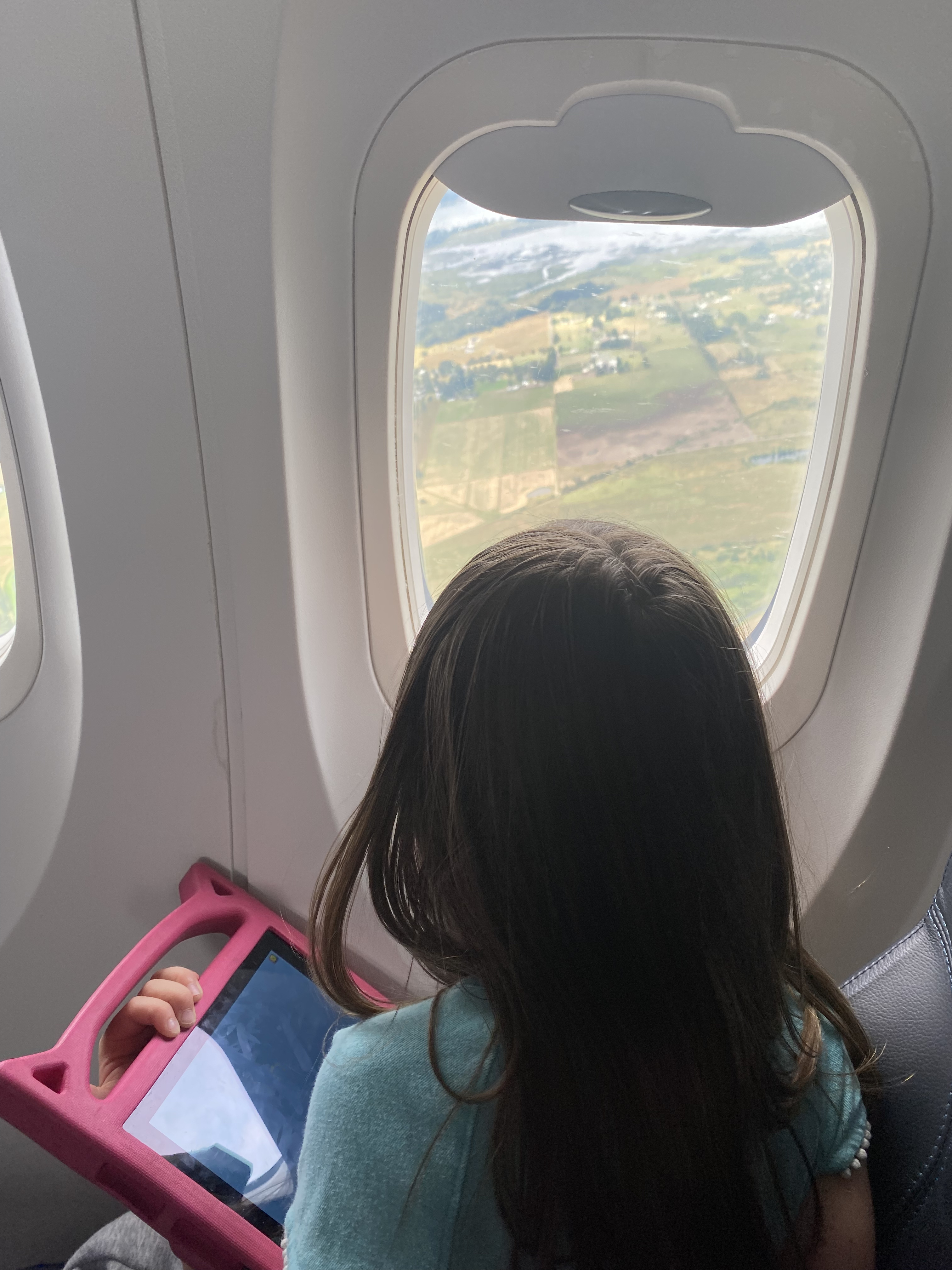
One of the best things about being a flight attendant is being able to fly for free on my days off! It’s super cool!
I finished training at the beginning of May, and so far, we’ve taken so many free flights that I quite honestly can’t count them. We’ve flown somewhere for fun at least 1x/month. We took a vacation to Cabo San Lucas Mexico. We took a vacation around Alaska. We’ve flown L to her aunt’s house in Oregon and back, and we’ve flown L to her grandparent’s house in Minnesota and back.
So how does it work?
Basically as soon as you start working for an airline in the US, your family (yourself, your spouse, your kids, and your parents) all get “non-rev” benefits on your airline. “Non-rev” means non-revenue; in other words, the airline makes no money from you flying. Having non-rev benefits means that we get to fly for free! It’s the greatest perk of working for an airline!
If we fly internationally, we do have to pay the taxes and fees incurred for the flight, so international flying is not completely free.
The problem with non-revving is that it’s standby travel. We show up at the gate and get open seats on the airplane. The only problem? Sometimes there are no open seats for us!
The key to non-revving successfully is being flexible and willing to modify plans as needed. When our family went to Mexico, we were initially planning to go to Hawaii, but the flights to Hawaii were so full that I was afraid I might not make it back in time for work, so…we went to Mexico instead!
Our Alaska trip was the most stressful trip in terms of non-revving. Particularly, when going to Katmai, we risked losing the money I had paid for our seaplane, as well as completely losing the opportunity to go to Katmai at all (since I only had camping reservations for one night) if anything went wrong with us getting on our flight into King Salmon, Alaska. (Thankfully, that portion of the trip went swimmingly). We did have a bit of a difficulty at the beginning of the trip: Our plan was to fly into Gustavus, AK on the first day of the trip. This meant we had to fly into Juneau first. The flight to Gustavus from Juneau was wide open, but getting to Juneau from Seattle looked a little more sketchy; there were just a few seats open. Then suddenly, on the day of the trip, the flights into Juneau from Seattle started to look more and more full. We showed up at the airport in time to get on the first flight of the day – which was fully booked. I wasn’t too worried, as people miss flights all the time! But, then the flight closed without any non-revs getting onboard – AND there were several (I think around 7) non-revs listed ahead of us! (That means that the others had priority over us because they had been working with the company longer). The next flight to Juneau was an hour-or-two later, but that flight was also full. I knew that all the other non-revvers who had tried to get on the first flight would likely try to get on that flight too, and we’d get nowhere! Luckily, I had noticed that there was a multi-leg flight that was leaving soon that would eventually end up in Juneau on that same day. We ran to that gate and the agent worked to get us on the flight. The agent had a hard time issuing us tickets and ended up having to manually do several things to get the tickets issued AND had to call a supervisor to get us on. This took so long that they had to delay closing the boarding door for us. The captain ended up coming out to see what the delay was in closing the boarding door, but he agreed that getting us on should be a priority. And they got us on! We had to land in several cities and switch seats in several cities, but we did eventually get to Juneau on the day we needed, and all for free!
Another interesting aspect of having flight benefits has been factoring in gas prices. My sister lives ~5 hour drive from us. Flying to her takes about 4 hours between the drive to the airport, going through security, waiting, and then flying. But if I drive to her I have to pay for gas, and if we fly, we get to her for free (well, actually for the price of transportation to Seatac from our house).
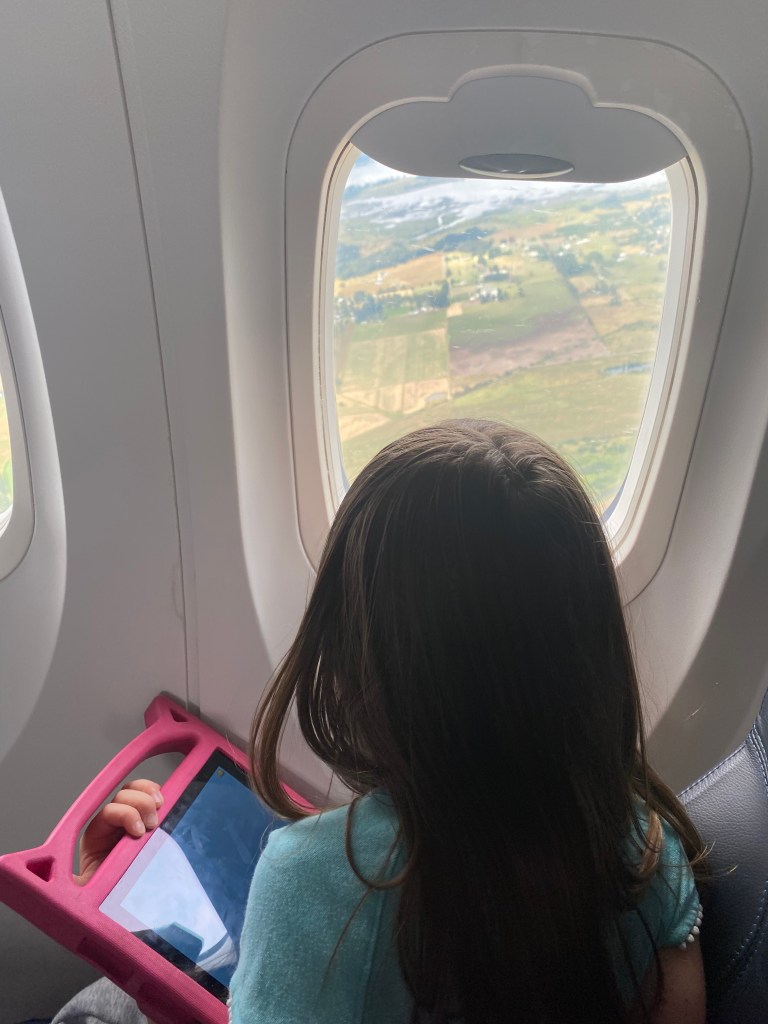
L non-revving to my sister’s house in Oregon. Right now, non-revving is pretty simple because I only have flight benefits on my airline, and I can see flight loads (e.g. see how many empty seats there are) through my company’s website/app.
In a few months (after 6 months of employment), flight benefits will open up on other airlines. That is when things will get more complicated. On the major US airlines, I will be able to fly domestically for free, though I will have to pay taxes and fees when flying internationally just as I currently do with my own airline. However, Saign and L will NOT be able to fly for free on other airlines. They’ll have to pay a fee (often around $100-200) to the airline in order to fly with them. This is where things get interesting: Saign and I have always chosen our vacation destinations based on where we can get cheap tickets. It seems that between the taxes and fees + the fact that the fees we will have to pay are only one-way, we are not convinced that we’ll save much money (if any) on flying internationally, unless we go to destinations that we’ve typically avoided because the airfare is so high. (We’ve never been to South America or Japan because I’ve never seen a particularly affordable deal on airfare to these destinations). Now, some airlines will upgrade their non-revs to first class or business class, meaning that for around the price of a coach ticket non-revs get to fly much more comfortably. The only problem with this? None of these airlines will let non-rev kids L’s age fly in these cabins. Until L is a little bit older, we’ll be stuck in coach!
The other thing that’s complicated about non-revving on other airlines is that I can’t see the flight loads. There are apps in which airline employees can share flight loads with one other, and that helps, but it’s not as easy as just checking for myself on my company’s website AND one of the three major airlines in the US prohibits their employees from sharing flight loads, so it’s not possible to learn flight loads for them.
Thus far, having flight benefits has been super cool, amazing, and worth the minor hassle. When we start trying to fly with other airlines, things will get much more complicated! I’ll keep you updated!
-
Our Latest Adventure: Katmai National Park
Saign and I have a goal to visit every US National Park together. In 2020 and 2021 we took road trips from Washington State to cover parks that were driveable-ish from our home. If our lives hadn’t changed so much in the last year, I suspect we would have taken our adorable truck camper on some new adventures to cover a few more parks. But, I decided that with the current gas prices and my new flight benefits, the most logical choice would be to cover some of the parks that we wouldn’t want to take a camper to. Enter: The Alaska National Parks!
There are eight national parks in Alaska, and only 3 are accessible by car! Oh hey! My flight benefits will work out great in this scenario. I started reading about the parks (This blog is one of the best resources on how to visit the parks on a budget IMO), and definitely the most exciting park to visit (from what I could tell) would be Katmai National Park. Why? It’s basically full of brown bears and you get to see them play and eat and fight and get pretty close to them and it just sounded magical and amazing.
But as I read more, visiting in 2022 seemed impossible. I started thinking about this trip a few weeks before I planned to go. Katmai is so popular that usually you have to get camping sites booked on January 5th, the date that they go on sale, and quite often even if you try to book as soon as they go on sale on January 5th, you won’t get camping permits. Ho-hum. I decided I’d have to save the Magical Katmai Bears for 2023…or so I thought! About 2 weeks before our trip, I happened to be up later than I should have been and I happened to go to recreation.gov and find camping permits for one night during the time I had off of work! I quickly paid for the permits and was so excited!
The next day, I did more research and learned that August (which is when we had permits) was not the best time to go to Katmai. July and September are when the salmon are running the strongest and when most bears can be seen. I hoped and prayed I’d still get to see some. Even if I got up close to just one, I thought it would be worth it.
To get to Katmai, there are commercial flights (free for my family and I on my flight benefits) to a town called King Salmon, but from there you have to take either a boat or a seaplane to Katmai. The boat at the time was $320, and the plane $350. As a family of three, and as someone who is very frugal, I considered this to be quite an expense. I really really really wanted to see bears if we paid nearly $1000 to get just 24 hours at the park! It felt risky to pay all that money to visit at a time that was not considered ideal.
It also felt a bit risky flying standby to King Salmon: if the planes there were fully booked, we’d miss out on our seaplane and our bears! I looked into staying in King Salmon the night before to give us a little insurance that we’d be able to board our seaplane on time, but all the hotels were booked up AND expensive AND quite frankly didn’t look very nice. There was camping that we probably could have done. Camping that was $150 a night + charged us extra to take showers!
In the end, while it felt risky, I decided that we would fly into King Salmon on the day we had camping reservations in Katmai. I was a bit nervous about things falling apart. In addition to the concern of not getting to the seaplane on time, seaplanes are not safe to fly in many weather conditions, so I was hoping and praying the weather would cooperate.
On August 3rd, we made our way safely to King Salmon! Buuut…then there was the matter of our baggage. We checked our camping gear and food and really didn’t have many options if our baggage didn’t arrive. Thankfully, our baggage arrived, and our driver from the seaplane company arrived, and everything was going smoothly. I was so excited! But still worried the bears might not be around.
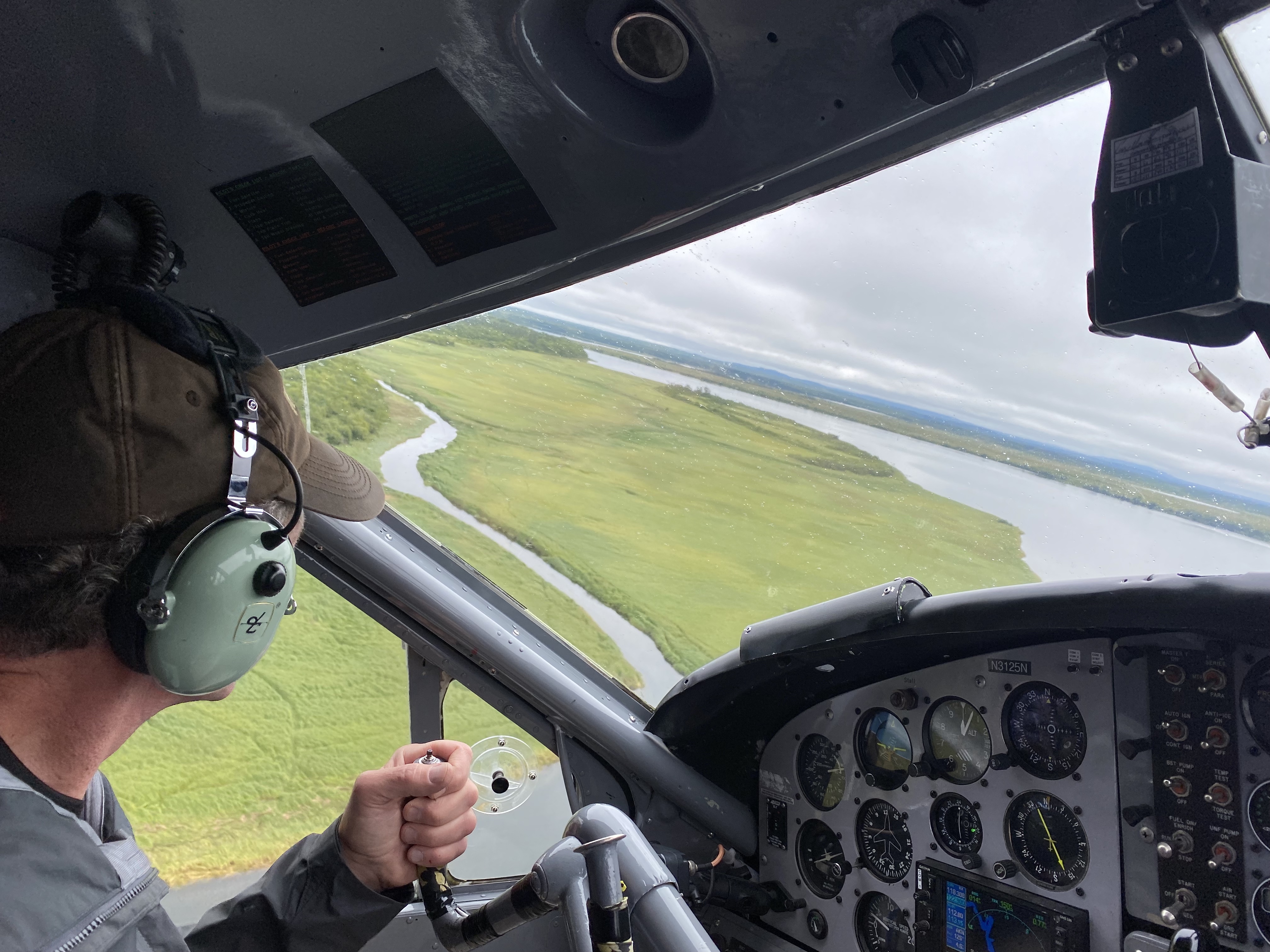
Our seaplane was supposed to take off at 2pm, but the company told us, “We’ll probably be able to get you there sooner.” And they did! They took just our family in our own little seaplane an hour early! As we were loading into the plane, the pilot asked, “Does anyone want to ride in the cockpit?” ME ME ME ME!
It was super awesome flying below the clouds on the way to Katmai! Our pilot did a few turns that I thought were for our entertainment. Later I learned that they WERE for our entertainment, but it was because he was trying to show us a moose. I didn’t see it!
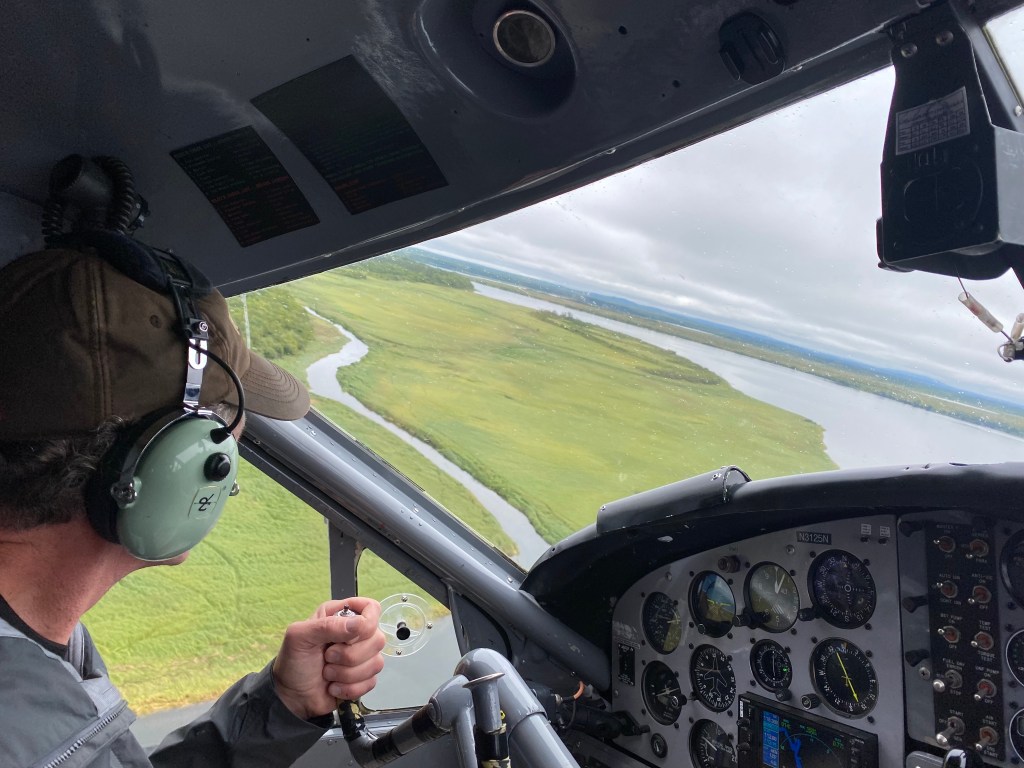
Flying as the First Officer to Katmai As we flew in towards Naknek Lake to land, there they were: Two brown bears just chilling on the beach!
My dreams were coming true! The magical Katmai Bears were there ready to meet me! So so so cool!
After we landed on the beach and were shuffled away from the bears, we got to attend “Bear School,” a requirement for all visitors to Katmai National Park where they teach you how to be safe around the bears. When you’re done with bear school they give you a cute little bear pin to show that you graduated.

L at Bear School From there, we headed off to the campground to set up our tent and THANKFULLY found a crazy excessive amount of camp stove fuel up for grabs (since you can’t fly with camp stove fuel we flew in hoping that we’d be able to score some at the campers exchange). From there, we went to look for bears!
The main spot to see bears is at Brooks Falls, which is a 1.2 mile walk from Brooks Camp. We walked a tiny bit over a bridge on the way to Brooks Falls and found several bears wading in the river, including some juvenile bears who were VERY noisy and upset when their mother wouldn’t share her salmon with them. So cool!

This Mama Bear was not sharing with her cubs! From there we hiked on up towards the Brooks Falls platform where we put our name on a list to be granted access to the Brooks Falls platform to watch the bears. They limit the platform to 40 people, so often during the day there’s a wait to go out to see the bears. Once you’re on the platform, you’re allowed 30 minutes to sit and observe and take pictures before your turn is up. Apparently during peak times that wait can be 2 hours+! Thankfully, we visited during shoulder season, so our longest wait to the platform was 15 minutes. While waiting, there was another platform where we were able to go observe bears, and even that platform was absolutely amazing. We saw tons of bears! I felt so lucky!
We finally got to the Brooks Falls platform where we watched bears playing and eating and lazing and salmon attempting to make their way up river, over a small waterfall (the Brooks Falls) to spawn. It was super cool! We got to see all sorts of different fishing techniques and disagreements between the bears and two adorable bear cubs.


As always, the best images will be on my instagram account: adventurefam_org And…that’s pretty much how our time at Brooks Falls went. We stared at bears a LOT. It was super cool! We learned that there are a lot of day-trippers to Katmai (since getting campsites is so difficult, and the lodge is crazy expensive and also difficult to book), so at night when the day-trippers left, we could watch the bears in a less crowded environment (when we were there, they weren’t restricting entrance to the Brooks Falls platform in the evening, so we could stay as long as we wanted. In the evening, I counted 27 bears at one time from the Brooks Falls platform. It was so cool!
I do wish that we had gotten two nights at Katmai, because that would have allowed all the glorious bear watching that we did, plus we could have gone for a hike at the Valley of 10,000 Smokes, which looks pretty cool in pictures. But even with just 24 hours, I still think it was one of the coolest things I’ve ever done in my life! Given the seaplane cost, I do see this as a once-in-a-lifetime thing to do, and don’t think I could justify spending the money to return to see the bears again, or to get the Valley of 10,000 Smokes hike in.
All-in-all, 10 Stars, would highly recommend visiting Katmai National Park!
-
Public Service Loan Forgiveness: A Success Story/Cautionary Tale
When I was 16 I decided that I wanted to spend my life helping teens navigate this difficult world.
When I was 20 I decided that the way to help teens would be to become a psychologist or a therapist.
When I was 24 I decided to start graduate school in Clinical Psychology.
At age 24, I knew that graduate school would be expensive. I expected it would cost me over $100,000. I also knew that I’d likely make 6 figures after I became a psychologist. I was so clueless about money at the time that in my mind, making 6 figures was equivalent to making 1 bajillion dollars. It felt limitless to me. Between my strong sense of calling and my minimal understanding of personal finances, taking out mortgage-sized student loans made perfect sense to me.
At age 29, I completed graduate school with ~ $182,000 of student loan debt.
“Good debt.” Remember, geriatric millenniels, how we were told that student loans were “good debt”?
In December after graduation I attended a party hosted by a friend I had gone to graduate school with. My student loans were still in their 6 month grace period, so I wasn’t paying them yet. My friend had graduated several years before me, and I asked her, “How’s it going paying off the student loans?”
“I’m doing public service loan forgiveness,” she told me.
“Public service whaaa?” I asked.
She explained that if you meet criteria for a “partial financial hardship” you can lower your student loan payments, and then if you make those payments on time for 10 years while working for the government or a non-profit, your loans will be forgiven after 10 years.
At the time, I was working for the government. This seemed too good to be true. In fact, even while she was telling me, I thought it was too good to be true. BUT just in case the program she spoke of did exist, I remember what it was called, and Googled it when I got home. Annnnnnnd – It did exist! For real!
As I read up on the program, while it did, indeed, exist, it certainly felt risky. First of all, I didn’t want my career dictated by a loan forgiveness program. (At the time I was on a two-year contract with the government, and didn’t know where I’d be going after that). Second, the program began in 2007, which meant that at the time (it was 2011), no one had yet had their loans forgiven.
After some thinking and discussion with my husband, we agreed that I would pursue Public Service Loan Forgiveness (PSLF), but that we would save as much extra money as we could, and if I left public service when my two-year contract with the government ended, I’d throw that extra money at my student loans.
When my grace period was ending, I called my student loan company and informed the customer service agent that I needed Income Based Repayment so that I could pursue PSLF. THANKFULLY this customer service agent informed me that PSLF would only be available to me if I consolidated all of my student loans to Direct Loans prior to switching to an income based repayment plan.
I did what he told me to do.
Since I had been in school for most of 2011, my loan payments were calculated at $90 per month for the next year. However, it took two months to consolidate and during that time, I paid $2000 per month (which was about half of my take-home pay at the time) towards the student loans.
When my two-year government contract was ending, I decided to follow my heart and choose the job I wanted without considering if it would qualify me for PSLF. I ended up getting a job at non-profit hospital, which meant that it would qualify me for PSLF.
At first this hospital job was meaningful and wonderful. Over time things started to change. I slowly lost autonomy. I was pushed to focus more of my attention on specific rules and regulations related to documentation and assessments, which took brain power away from what I really cared about, which was helping kids. My hospital began hyperfocusing on things that didn’t really reflect good clinical work; I began being judged on patient satisfaction scores and productivity.
The job slowly became less enjoyable, but I continued to work hard and do my best. While the job wasn’t fantastic the way it had been, it was tolerable at worst and still meaningful at best.
At some point, around 2017 or 2018 I had a pretty important conversation with my boss about productivity. I experimented with seeing more patients in one day, and found that the quality of my work suffered when I saw too many patients. We agreed to scheduling a specific number of patients per day in order to balance productivity with quality work. She told me, “What you’re doing is perfect. We’ll never expect you to do more.”
And then the pandemic hit.
Oh, did it hit hard.
Suddenly my supervisors were incredibly worried that our clinic would close. In my opinion, they became so hyperfocused on that that they stopped worrying about the day-to-day needs we had in our clinic, and stopped focusing on us employees. We couldn’t get support for basic problems and issues that came along. Meanwhile, the hospital took a huge financial hit. Sooo…we were told we had to do more. I reminded my boss of what she had promised me years back, and reminded her that I could not do a good job if productivity expectations were increased. She told me that I was paid a lot and should expect to work more. I asked her for a pay cut in return for reasonable working conditions. She said that she couldn’t give me a paycut but that I could consider becoming a part-time employee.
Oh. Did I mention that to qualify for PSLF, you must be a full-time worker? Reducing my work hours was not an option for me. I felt trapped.
At this point, I had 2.5 years left until my loans would qualify for forgiveness, by my loan company’s count (which wasn’t actually incorrect, I had 3 payments that the loan company was not counting for unknown reasons, and 3 additional payments I made that wouldn’t count either because my loans had been put on administrative forbearance or because I made them prior to being put on the lower payment plan).
I felt trapped.
At this point, because I had been paying so little on my student loans, they had grown to $230,000.
So now, if I stayed at the hospital I had been at for 6 years I’d be forced to work in a way that didn’t feel good or right to me, and which would push me into burnout and resentment. I knew that.
I felt trapped.
Now, for PSLF, I could work for any non-profit or government job. The only problem? I’m a crazy good child psychologist, and I couldn’t figure out anything else that I’d be good at in the public sector. Buuut, I realized that I could look for another Child Psychologist job. And so I did. About a year into the pandemic, I had a job offer for a job that I thought *might* make me happier than the job I was in. The only problem? I wasn’t sure I’d be happier. The new job was not offering compensation that matched my old job. I was so burnt out and miserable at the old job, and I was scared that I’d move my family across the country to the new job and be just as miserable + have caused a major disruption to my family.
I ended up not taking that job.
But again, I was miserable at my job and felt trapped.
Meanwhile, things were changing in relation to PSLF. There had been too many problems with loan companies miscounting payments (as I mentioned happened to me). There had been too many problems with people being in the wrong loan type (as mentioned above, I happened to be in the correct loan type thanks to the customer service guy who helped me when I called the loan company back in 2012, though I had made a few payments prior to consolidation). Finally, there was a huge problem with people being forced to stay in their non-profit jobs well after the 10 years of service needed to qualify for PSLF because the rules as they were written stated that in order to receive loan forgiveness, you had to still be working with a non-profit when the loans were forgiven (so people would stay in jobs for months to years waiting waiting waiting, it was terrible). Around October 2021, a ruling came out to remedy all of this. Loans were to be forgiven after 10 years of payments while working for a non-profit, even if an individual no longer worked for that non-profit at the time of forgiveness. Any payments made to government loans while working for a non-profit would qualify as a payment, even if not a Direct Loan.
Freedom was getting closer!
By my count, I had 6 extra payments that should qualify with the new rules (3 that were made on the wrong loan type + 3 because my loan company was simply bad at counting). MOST IMPORTANTLY, I didn’t have to stay at this job that made me miserable waiting for my loans to be forgiven; As soon as my 10 years were completed, I could quit! I would qualify for PSLF in February 2021!
In December 2021, my family took a trip to Greece. While on the airplane, I looked at the flight attendants, and I told my husband, “I think I’m going to do it. I’m going to become a flight attendant.” Before my job got really bad during the pandemic, I had planned to retire from psychology at age 50, and had always told my husband that my “fun job” after we reached financial independence would be to be a flight attendant.
In January 2022, I began applying to airlines.
In February 2022, I got a job offer at an airline and put in my notice at the hospital. A day later I realized that my loans had been forgiven. This didn’t make sense, because I hadn’t even put in the paperwork proving that I had made my 10 years of payments. I then remembered the new rule about all payments on government loans counting towards PSLF: In 2011 and 2012, I made payments on some undergraduate loans right after I completed graduate school, which then got consolidated in with my graduate school loans. Now and those payments counted!
Jubilee! I was freeeeeee!
From a purely numbers perspective, I am absolutely a PSLF success story. Because I was making minimum payments on my student loans, I was able to buy a home and save a lot for retirement. PSLF was a MASSIVE leg-up for me!
From an emotional perspective, this is a failure story. I stayed at a job that was clearly not right for me because I had student loans that I was waiting to have forgiven. If I hadn’t been pursuing PSLF, I would have left my job as soon as there was a problem and would most likely still be working in private practice as a psychologist today. As it is, the world lost a crazy good child psychologist because I’m too dang burnt out to consider returning to psychology any time soon.
I think anyone who has student loans and is pursuing financial independence should CONSIDER how PSLF might benefit them. But they also should consider how it might hurt them. Also, I want anyone reading this to know: The special rules that went into place in October 2021 to make Public Service Loan Forgiveness easier only lasts until October 2022. You MUST consolidate your student loans into Direct Loans by October 2022 if you want to qualify! Go do it today!
-
First Month as a Flight Attendant in Numbers
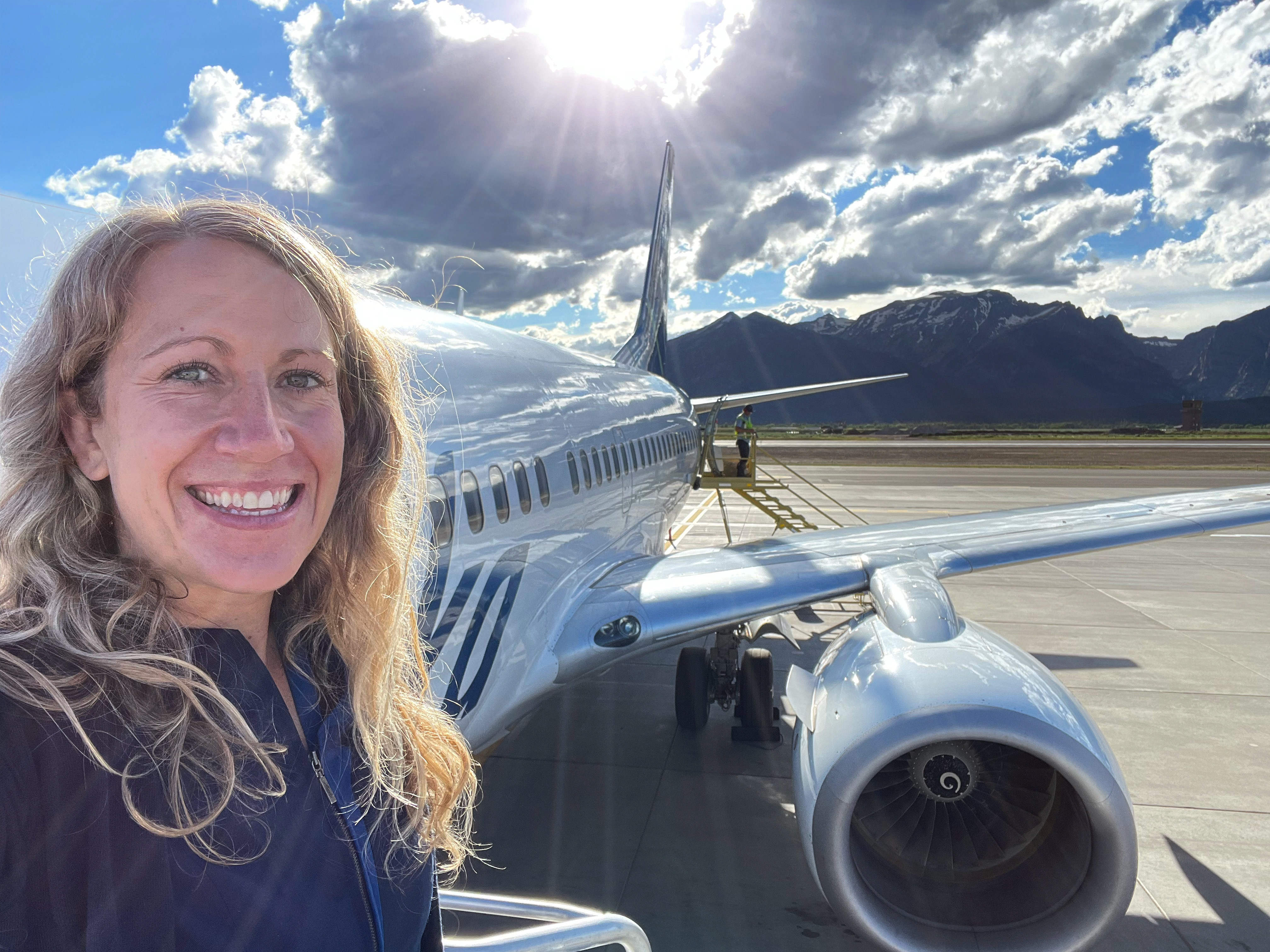
I made it through my first month as a flight attendant. It was June 2022, so a 30 day month. Here are the numbers:
Days assigned as a reserve: 18
Days used as a reserve: 15
Total Trips for the month: 5.3
24 hour + layovers: 4
Days converted to Emergency/Extended Reserve: 1
Days on airport standby: 1
Phone calls to home from crew scheduling: 2
Total hours: 102.70
____________________________
And now, an interpretation of the numbers:
Days assigned as a reserve: 18
This is the standard amount of days that a reserve is required to be on-call per month. What this means is that, 18 days this month I was required to be within 2 hours of the airport in case they needed me to fly.
Days used as a reserve: 15
As mentioned above, I had 18 days this month in which I had to be within 2 hours of the airport in case the airline needed me. However, for 3 of those days, they didn’t need me and I stayed at home and worked on projects.
Total Trips for the month: 5.3 (I had a 3 day trip that began on the last day of the month)
I had 6 separate trips ranging from 1 day turns (in which I flew out of Seatac and back within one day), to 4 day trips (in which I stayed over night at hotels in other cities).
24 hour + layovers: 4
24 hour layovers are pretty amazing; For longer layovers like this, the airline will typically transport the crew into the city center so that we can explore and enjoy the city. I felt pretty lucky to get four this month: Raleigh, Miami, Detroit, and Atlanta. I also had quite a few layovers that were not 24 hours, but were long enough for me to get out and hike or explore.
Days converted to Emergency/Extended Reserve: 1
During the month of June, I was on “A.M. Reserve,” which means that the airline can call me anytime between 12am and 2pm to tell me that I must be at the airport, again any time between 12am and 2pm. However, sometimes they convert flight attendants to “ER Reserve” which means that they can call you anytime within a 24 hour period. This isn’t really ideal, because it keeps me tethered to the Seattle/Tacoma area for the full day. The airline is allowed to do this 2x per month before they have to pay us a little extra if they use us on ER Reserve.
Days on airport standby: 1
Remember above, when I mentioned that I had 18 days on call and had to be within 2 hours of the airport? Well, sometimes they have us sit airport standby. For airport standby, instead of waiting for a call at home, we sit at the airport in case they need us on very short notice. It’s pretty boring sitting at the airport with nothing to do, so I’m grateful that it only happened to me 1x this month!
Phone calls to home from crew scheduling: 2
When on reserve, crew scheduling will often call a flight attendant to tell them that they have an assignment. I got called once at 3am for a 6am report, and was called once at 10:45am for a 1pm report.
I don’t like calls from crew scheduling because it’s a bit disruptive! I was able to limit my calls from crew scheduling by self-assigning (as reviewed here) when able, and by checking my airline’s crew scheduling website with some frequency. As mentioned above, crew scheduling is only allowed to call between certain hours of the day. For June, it was 12am-2pm for me. If I had reserve starting at 12am, I would check the crew scheduling website before I went to bed, where I could click a button acknowledge any assignments they had for me. Doing so meant that I was able to avoid middle-of-the-night phone calls and worrying about missing a call!
Total hours: 102.7
As previously written about, while on reserve, I am guaranteed 90 hours of pay per month, regardless of whether or not I worked those hours. I hoped this month to get a few free hours! I failed though, and worked all of the hours I got paid for – 102.7 of them. However, towards the end of the month I learned that if you work 5 hours more than your guarantee, you get a monetary bonus, so now I’ll probably be trying to work more than my guarantee vs sitting at home.
___________________________
All-in-all June was a great month! I am really enjoying this new life!
-
Waiting for the Phone to Ring – Reserve Life
Another post about the bizarre world of being a flight attendant…
Right now I am on “reserve” for my airline. What that means is that I’m on-call. I never know where I’ll be flying until the day before the trip…if I’m lucky. I could know just 2 hours before I need to be at the airport.
With my company while on reserve, you get 12 or 13 guaranteed days off per month (depending on the length of the month). The other 18-ish days, you’re on-call. Usually you’ll be on-call for either A.M. (midnight-2pm) or P.M. (10am-midnight). What that means is that Crew Scheduling is only allowed to assign you trips and call you between those hours. Crew Scheduling is also allowed to change you to “ER” reserve, which means they are then allowed to call you any time in a 24 hour period.
While on reserve, you can also “self-assign” trips, which means that you can sign up to fly during your reserve period. However, there are lots of restrictions to what these self-assignments can look like. Right now, I’m on A.M. reserve for 4 days, so the day before my reserve started I was able to go on to the company’s scheduling website and look for 4-day trips that start in the morning to sign up for. Yesterday there were ZERO available that fit that criteria! Today I got on to look for 3-day trips, and I tried to get one, but someone else got to the trip I wanted before I did, so I wasn’t able to self-assign. In other words: self-assigning doesn’t always work out. If it works out, it’s kind of nice because I’ll know the day before the trip where I’m going and when and don’t have to live in fear that I’ll be called in last-minute for a trip.
While on reserve, you’re guaranteed to be paid for 90 hours of work. (I know that sounds low, but flight attendants are pretty much rarely paid for the work that they do; usually they’re paid only when the airplane doors are closed, it’s super bizarre). Anyway, so I’m guaranteed to be paid for 90 hours even if I work less that that. However, I get paid a tiny bit more for hours that I actually fly.
With this bizarre pay system in place, I’ve decided that reserve life should be one of two extremes: Either I should try to work quite a bit MORE than the 90 hours I’m guaranteed and make as much money as I can, or I should try to work as little as possible and get paid for sitting at home.
Thus far, I’ve NEVER been called into work (I have the system set to call all people who want to work before they call me to force me to work), and have self-assigned all the trips I’ve gone on. This is fine (Yay! I’ve gotten 15 days off this month and might get more!). I decided that June will be my low-fly month; my goal will be to get paid for hours I didn’t work and to spend a lot of time at home. In July, L will be out of town quite a bit, so I’ve decided to make it a high-fly month and try to work as much as I can (at least when she’s out of town).
Flight attendant life can be quite flexible. This little post explains just one way that I can manipulate my schedule to make it something that works for me and my family. I’m still loving this new career!
-
Subscribe
Subscribed
Already have a WordPress.com account? Log in now.
 Adventure Fam